Potteric Carr Wildlife
Railways
Railway developments at Potteric Carr 1849 to 2010
During the 30 years before Potteric Carr was declared a nature reserve, there were regular sightings there of Osprey, Merlin, Flamingo and Kittiwake not to mention the occasional Sea Eagle. Before you rush away to check why these had never featured in the local bird reports, it should be said that these were the names on express locomotives which regularly passed along the East Coast Main Line. Potteric Carr has long been the focus of an unusually complex railway system and it is this which remains, perhaps, one of its most distinctive features. Railways have been crucial to the site’s development; without them there might not have been a nature reserve.
Railway construction at Potteric Carr commenced in the late 1840s and finished just prior to the First World War. Much rationalisation and reduction of the system has taken place since then. The first line across Potteric Carr, and still the most important today, was the main line of the Great Northern Railway (GNR), authorised in 1846 and destined to become part of a direct London – Edinburgh route. Earlier north/south routes surveyed in eastern England had all avoided Doncaster, but the GNR passed through the town at the insistence of one Edmund Denison, a Doncaster man who was a member of Parliament for the West Riding of Yorkshire. This was to change the future of the town overnight. Its position was reinforced in 1853 when the railway workshops were established there, bringing an influx of workers and their families into the area. The section of the GNR, which passes through Potteric Carr and continues to survive as the East Coast Main Line (ECML), was opened from Retford to Doncaster in September 1849.
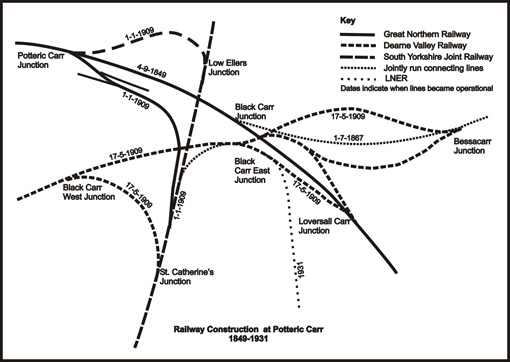
Railway construction at Potteric Carr 1849—1931 © John HancoxJust over 10 years later the second part of the Potteric Carr railway jigsaw appeared with the construction of the line to Gainsborough. This began life under the GNR who opened it for goods on 1st July 1867 and passengers two weeks later. The Great Eastern Railway (GER), operating mainly in the eastern counties with large track mileages but little traffic, saw joint operation of this line with the GNR as a way of gaining access to the lucrative South Yorkshire coal. Initially they were to share the cost of building the Gainsborough line, thereby receiving authority to run trains on GNR lines to Wakefield. A last minute change of mind prevented this happening and it was to be 15 years before the GN & GE Joint Committee was set up under an Act of Parliament in 1879. This Committee took over the running of a joint main line between March (Cambridgeshire) and Doncaster, including the Gainsborough to Black Carr section, on 1st August 1882. With the opening of the main line and the link to Gainsborough another 30 years were to pass before any more railways were built on Potteric Carr.
Around the turn of the century two lines were proposed, both owing their existence to the development of the rich, local coalfield. The first was the Dearne Valley Railway (DVR). This line, which was authorised in 1897, was once described as the most important purely mineral line in Britain. It connected with several railways, including the GNR and the GN/GE Joint at Black Carr, and its close ties with the collieries can be seen from its list of directors which included men closely connected with Carlton Main, Grimethorpe, Hickleton Main, Houghton Main and Manvers Main collieries. It was operated by the Lancashire and Yorkshire Railway (L & YR) which had a controlling interest in the company. Where this line joined the GNR and GN/GE Joint at Potteric Carr, flying junctions were used to avoid conflicting movements with the fast moving traffic on the main line. A braced girder bridge carrying a double track was built over the GNR and this bridge is still in use today.

The bridge at Bessacarr with an electric train passing © John Hancox
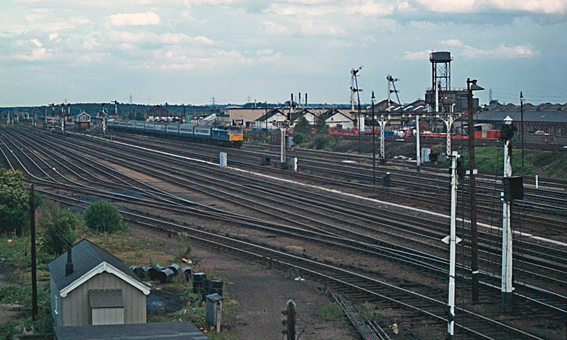
The second line was the South Yorkshire Joint Railway (SYJR). This linked Dinnington with Kirk Sandall, again crossing Potteric Carr. Its target was the coalfield to the south east of Doncaster which had been slow to be developed due to technical and geological problems. The highly profitable SYJR was so called because it was jointly operated by five companies, the Great Central, GNR, L & YR, Midland and North Eastern. This was seen as a sensible compromise and much better than a plethora of small independent lines. Authorised in 1902, the SYJR, including connecting curves, was opened on 1st January 1909. One of these curves was the Low Ellers Loop which had been authorised in 1903 and was built in order to deliver coal trains to the ‘up’ sidings without conflicting with main line traffic. The GNR had extended its sidings onto the area of the former Doncaster Duck Decoy in the 1890’s calling them, appropriately, Decoy Sidings. In order to connect its sidings with the SYJR, the GNR built a line from their ‘down’ yard to St. Catherine’s Junction. This line enjoyed a life of just two years from 1909 to 1911 – visitors may remember this as the Old Decoy Bank (it was removed in 1975 – see below). By 1910 all but one of the ‘spaghetti’ junction of curves were in place.
Decoy Sidings © John Hancox
The last line to be built was the connection with Rossington Colliery which was built some years later in 1931. This is the bank we know as Rossington Bank which originally crossed the bridge at the end of Piper Marsh and crossed what is now Huxter Well Marsh. The system remained intact until May 1972 when the former DVR and its connecting curves to the ECML and former GN/GE Joint Line were closed.
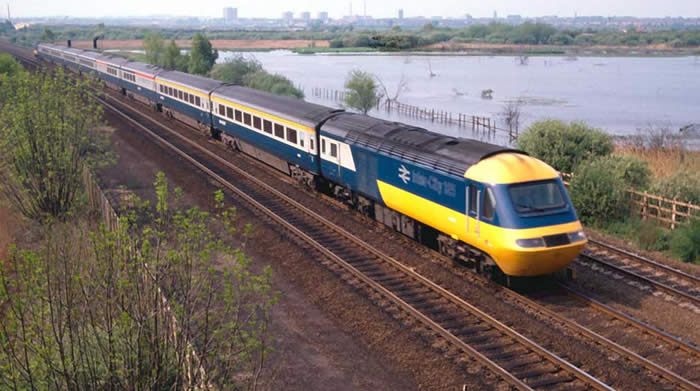
However, this was not the end. The mid 1970’s saw another period of railway building and rationalisation on Potteric Carr. This time it was to make way for the introduction of the new InterCity 125’s on the ECML. The junction with the Gainsborough line was realigned and flyover links were built making use of some of the by then disused track beds, bridges and embankments. The old Decoy Bank was finally removed to provide material for a new Decoy Bank which more or less duplicated the earlier one but at a lower level to allow the new Lincoln Line overpass to merge into it. The whole of these changes came into operation on 2nd May 1977 in good time for the introduction of the HSTs in May 1978.
High Speed Train (HST) passing Low Ellers in 1981 © John Hancox
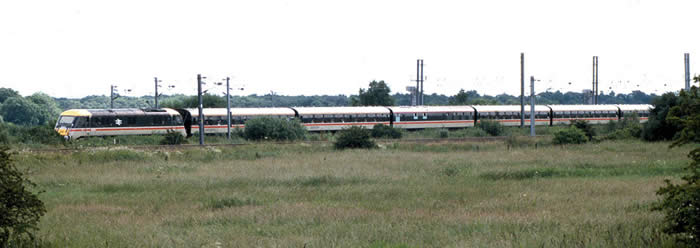
The next stage in the railway’s development was the electrification of the ECML in preparation for the introduction of a new range of electric locomotives with potentially a higher top speed – but the timing improvements of journeys were mainly as a result of improved acceleration. From the Reserve’s point of view, this was somewhat unsatisfactory as it meant the erection of unsightly steel gantries to support the catenaries – isn’t it amazing that the bird one wants to see on Low Ellers is always behind one of the gantry posts! On the other hand, the engines are much quieter than the former HST125s which still use the line for some workings. The electrification was completed in 1988 and the first northbound test train passed through the Reserve on 3rd July 1988. The date was chosen as it was the 50th anniversary of the setting of the world speed record of 126 mph for a steam hauled train achieved by LNER Class A4 Mallard in 1938.
The first electric train hauled by a class 89 locomotive passing through Potteric Carr, 3rd July 1988 © John Hancox
Text © Dr Malcolm Parker
Further reading
Batty, S. R. (1991) Rail Centres: Doncaster . Ian Allan.
Barnett, A. L. (1984) The Railways of the South Yorkshire Coalfield from 1880. Railway Correspondence and Travel Society.
Goode, C. T. (1975) Railways in South Yorkshire . Dalesman.
Footnote by John HancoxDuring the development of the Reserve, reminders of the former days of the railways were always appearing. In Childers Wood, which was used for many years as an area where the engines were cleaned, i.e. smoke boxes emptied and presumably carriages also (as in one place there was a lot of broken crockery!). Also, in this area, on two occasions in the past, railway wagons have been lost “down the bank” and presumably were not felt worthy of being recovered. Most of the frame and wheels of the latest to be lost ( circa 1940) are still visible — the only parts of the earlier one ( circa 1913) that are still visible are one wheel and some of the frame.
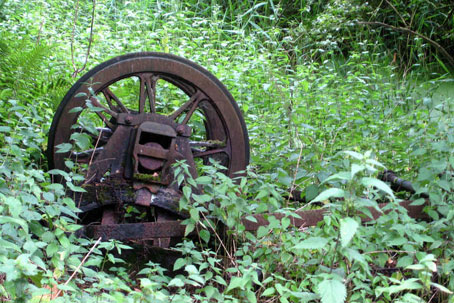
Remains of the first, earlier wagon at Childers Wood © John Hancox
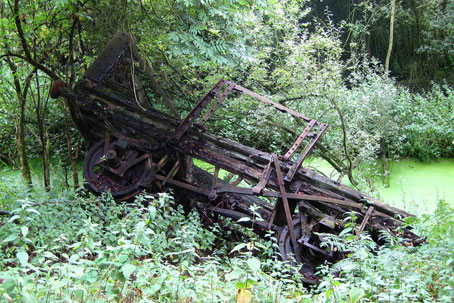
Remains of the second wagon at Childers Wood © John Hancox

A refurbished wagon of the same type as above, at the Midland Railway Centre © John Hancox
Another interesting feature, now removed, was a gun emplacement on the junction of the SY Joint and Low Ellers loop which was placed there during the Second World War presumably for the defence of Doncaster!
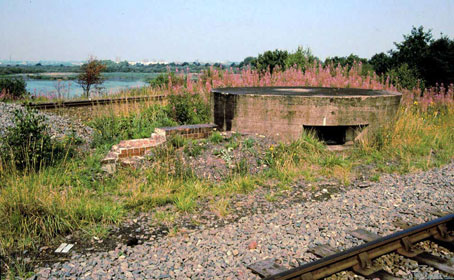
Gun emplacement at Low Ellers © John Hancox
When the Low Ellers signal box, from which the signalman must have had excellent views across Low Ellers, was removed in May 1980, much of the work was carried out by Reserve volunteers and one of the name boards, which carries the name chosen for the café, is now on display in the Field Centre.
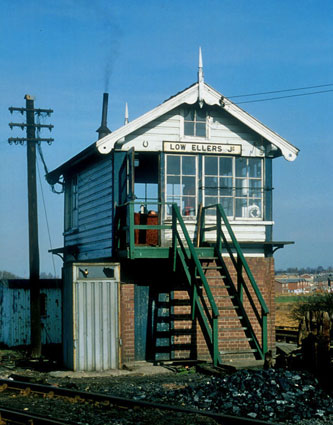
Low Ellers Signal Box © John Lintin Smith
There is an occasional “blast from the past” when restored express steam locomotives pass through on one of the lines – included is a shot of a restored LNER locomotive, 60019 Bittern, passing through Potteric Carr on a Talisman rail tour.

60019, Bittern, passing Low Ellers Marsh in 2008 © S. Drinkall
More photographs of steam locomotives passing through Potteric Carrin 2008–09
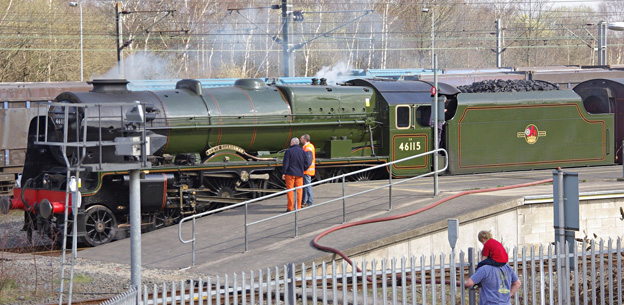
SCOTS GUARDSMAN 46115 taking on water just after passing Decoy Junction South on 22nd March 2009 © John Hancox

SIR NIGEL GRESLEY , 60007, passing Decoy Junction South at Potteric Carr early evening of 14th March 2009 © Allan Parker ARPS

OLIVER CROMWELL , 70013, passes Potteric Carr on the up line, on 28th February 2009 © Trevor Feltham
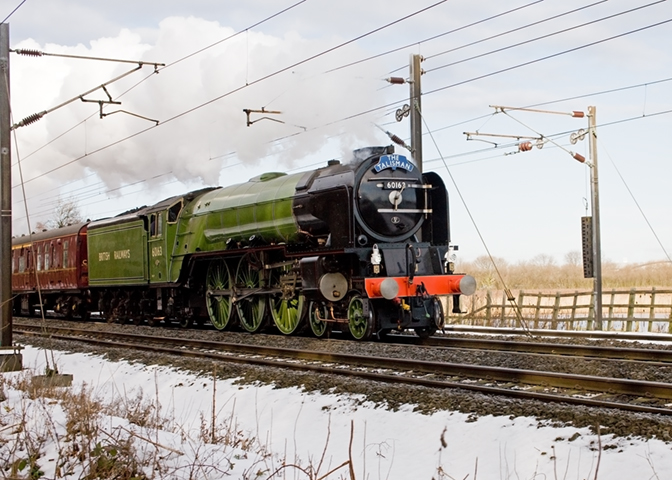
The splendid, just-built, Peppercorn-designed class A1 steam locomotive, TORNADO , 60163, seen passing Potteric Carr on a southbound express Darlington to King's Cross rail tour on 7th February 2009 © Allan Parker ARPS
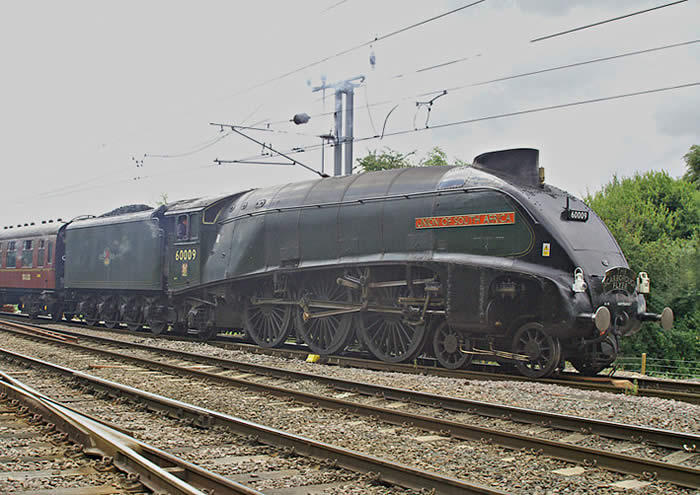
UNION OF SOUTH AFRICA , 60009, passes Decoy South Junction, Potteric Carr, at 12.10pm on 12th July 2008.
Another one of the Gresley pedigree A4 steam locomotives passes through Potteric Carr. Exclusively built at the LNER Doncaster 'Plant' workshops in the 1930s, these powerful, streamlined steam engines were designed to work the East Coast Main Line express passenger services. 60009 has been one of the most active A4s in preservation and is seen here in its British Railways era Brunswick Green livery heading a rake of mixed coaching stock. After a stop for water the chartered ‘Scarborough Flyer’ rejoined the ECML and steamed northwards © Trevor Feltham
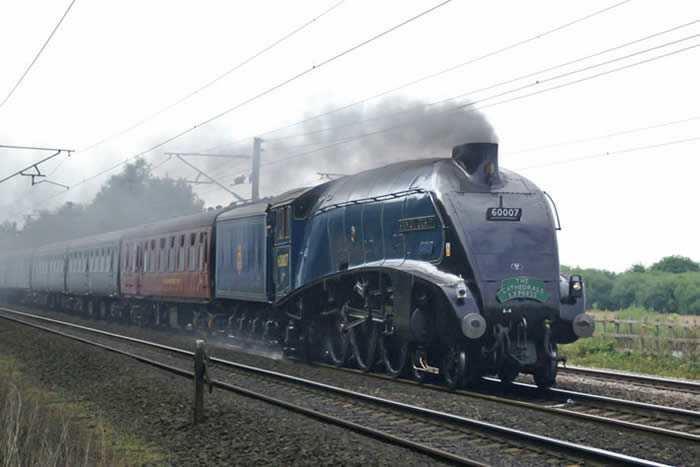
SIR NIGEL GRESLEY , 60007, steaming southwards past Low Ellers Marsh at 4.45pm on 31st May 2008 © Trevor Feltham