Recording ¦ Surveys ¦ Publications
Surveys
The Potteric Carr 2012 Bittern Census — a report by Dave Carroll
This year’s annual Eurasian Bittern Botaurus stellaris census at Potteric Carr was carried out on 29th January 2012, co-ordinated by YWT Field Officer, Mark Roberts. Clipboards with forms were placed in key hides so that observations could be logged through the day by census volunteers and Reserve visitors. This resulted in just one Bittern registration, quite late in the day at Decoy Marsh from 3.20pm to 3.40pm (RJ Scott, W & J Badger et al .). From earlier observations during this winter we know that two Bitterns were present in November, which remains the peak figure for 2011-12 so far. With two months of the 2011–12 winter remaining it looks as though this will be the poorest winter for Bitterns at Potteric Carr for a decade.
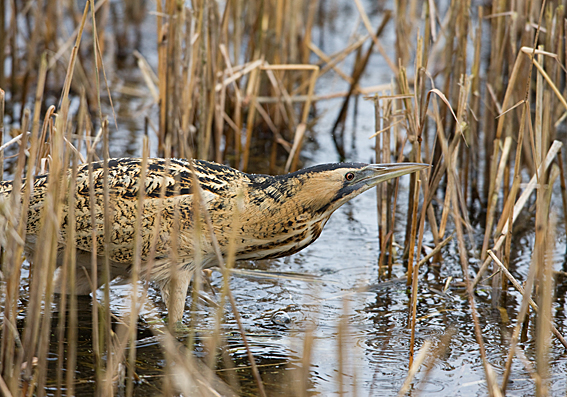
Bittern at Potteric Carr in 2010 © Allan Parker ARPS
Rigorous observations combined with a Bittern census each winter means that local ornithologists have built up a detailed record of peak numbers on the Reserve at any one time during the season. YWT’s Potteric Carr became nationally prominent for its remarkable show of wintering Bitterns, peaking at six in the mid-2000s. Birdwatchers and photographers came to Piper Marsh from far and wide, where this cryptically plumaged bird was comparatively easy to see in the cut reed, less than twenty metres away from the observation hide.
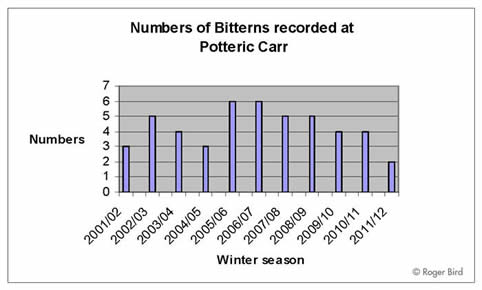
Figures in the bar chart above are taken from PCNR published bird reports, scientific papers, and the Reserve’s annual Bittern censuses. They are not estimates, but specific numbers of birds present in the winter season October–March, from 2001 onwards. The 2011–12 figure is provisional, however, only covering October 2011 to January 2012. Unless more than two individuals are proved before the end of March this year, the bar chart demonstrates that 2011–12 has been the worst winter for Bitterns at Potteric Carr in the past ten years.
Reasons for the Reserve’s Bittern decline since 2009
The present low number of Bitterns is thought to be caused by a combination of factors. Severe, sub-zero winters in 2009-10 and 2010-11 left Potteric Carr’s water bodies continuously frozen for a number of weeks. The thick ice made it impossible for reedbed-specialist Bitterns to catch their aquatic prey such as Perch Perca fluviatilis and other creatures in the reed swamps. Providing sprats for them as part of a supplementary feeding protocol, as advised by the RSPB, was delayed at Potteric Carr. Bitterns had to abandon the Reserve to find sufficient food elsewhere.
Then followed a prolonged regional drought which saw water levels reduced or disappear completely by mid-summer 2011. Pumping water into Huxter Well Marsh from Mother Drain was insufficient before a drought order ban on abstraction was imposed by the Environment Agency. Sadly, many of Potteric Carr’s waters lost their fish stocks, in particular, key Bittern habitats such as Piper Marsh, Low Ellers Marsh, and cell 4 at Huxter Well Marsh which had been stocked with Rudd Scardinius erythropthalmus in 2009. An American Mink’s Mustela vision excess food cache was discovered on a Piper Marsh island, showing that not only Grey Herons had taken the last stranded fish.
Fortunately for the displaced Bitterns, but perhaps another factor in the decline at Potteric Carr, is the increased availability of reedbed habitats elsewhere in Yorkshire. For example, Old Moor near Barnsley has had up to three Bitterns, a site record, in January 2012.
The future for Bitterns at Potteric Carr?
Potteric Carr’s dedicated Bittern reedbed habitat was created at Huxter Well Marsh in 2004–07, receiving over £1.6m in primary grants, including funding from the EU Life Nature Programme ‘Reedbeds for Bitterns Project’.
Since then, the RSPB recommends that water depths be higher than previously thought for breeding Bitterns. Huxter Well Marsh will need a revised water management regime to ensure that water levels can support nesting Bitterns throughout the season. The Potteric Carr waters where fish vanished in 2011 need to be re-stocked so that conditions become attractive to wintering and prospective, booming, Schedule 1 Bitterns in the near future, and recover the Project target dates for the Reserve's flagship-species.
Willow Tit monitoring
This is an ongoing survey to monitor Willow Tits visiting the feeding station at Willow Pool by participating visitors to the Willow Pool Hide. A form to add your sighting of Willow Tit is pinned to the hide notice board. Willow Tits have declined by 95% nationally in recent years. Potteric Carr is recognised as a regional stronghold for this species, so it is necessary to monitor them closely on the Reserve. The survey compliments a survey of Willow Tit breeding territories carried out by PCNR Survey & Monitorng Group volunteers.
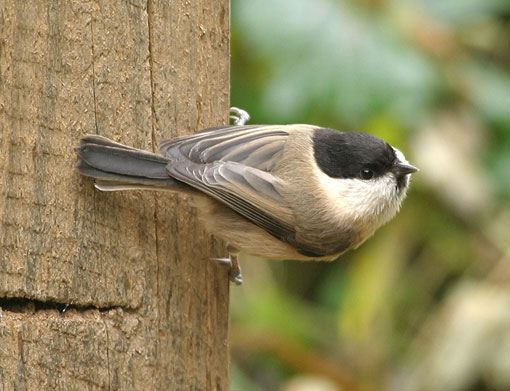
Willow Tit at the feeding station hide © Adrian Andruchiw
Early and late dates for Butterflies and Dragonflies at Potteric Carr © John Hancox

Observers are asked to report early and late butterfly dates at Potteric Carr. The table (PDF link above) gives guidance on previous extreme dates and mean dates up to the end of 2011.
Nestbox Scheme
 (A report by Roger Bird).
Recording
Submitting your natural history records electronically to YWT via this website
It is now possible to send in your sightings of Potteric Carr birds, wildlife and other natural history on the form (Microsoft Excel template) below. When you have filled in you sightings please return the form to our Recorders at this address. The codes needed to pinpoint your sightings can be found under 'Potteric Carr Recording Codes and Maps'. You can send in forms at any time but it is suggested that records are sent in each month, and separate forms are used for birds, butterflies, plants, dragonflies, etc., to help processing. Records of rare species discovered at Potteric Carr will also need to be supported by a separate field description. Observations may be used by YWT in the development of a Conservation Management Plan for the reserve, and by FOPC for publishing annual reports.
Potteric Carr Recording Form
(105kb .xls) For submitting detailed records.
[Right click on the Recording Form link above. Click 'Save Target As' to save the file. Click on the saved file icon to open the form. (You need to have Microsoft Excel installed on your computer). Fill it in with your record/s. Column headings in Red on the form must be filled in. Click 'Save'/'Save As' and name the file (example: "Potteric records"). Click on the FOPC website email link on this Page. Attach your file "Potteric records" to the email. Click on 'Send'.]
An alternative to filling in the form is to simply send your records to the FOPC email address stating your name, date of observation, species, numbers and location — thank you. Soon, there will also be paper forms available to fill in your observations on site (held in the reception shop and in the nature reserve café) if preferred.
Potteric Carr Recording Codes and Maps
From 21st April 2010 a revised set of recording codes began at Potteric Carr. Four new maps with codes are now available in the table below for you to make use of and/or print out. Also, there is an index of Potteric Carr Recording Areas in the separate link below.
 )
)
 )
)
 )
)
 )
)
 )
)


 (Review of 2004)
 (Review of 2005)
 (Review of 2006)
 (Review of 2007)

