Potteric Carr Wildlife News (January–March 2012)
March 2012
Saturday 31st
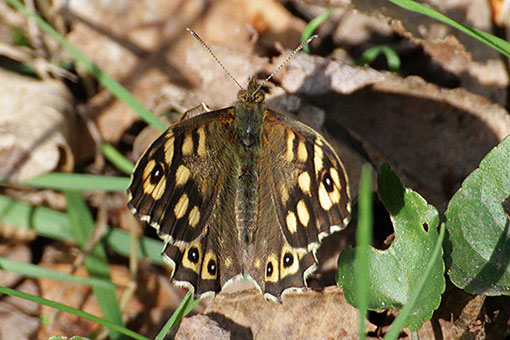
Records from Ray Collins for yesterday, 30th: Speckled Wood (four seen on Butterfly Alley), Orange-Tip (at least six seen across the reserve), Comma (near Hawthorn Bank north) and several Peacock were also seen on the path near the Lighted Crossing.
Speckled Wood, 30th March © Ray Collins
Friday 30th
I took this photo of a vole near St. Catherine's hide before realizing it was in trouble, it was wrapped around a Bramble shoot, it took a while and a fair bit of pain to free it (being similar to Velcro) but it did get free and no worse for wear in the end (Colin Huntington).

Vole species caught in Bramble © Colin Huntington
A day-flying Orange Underwing moth was photographed on the ground under birch trees near Piper Marsh hide.
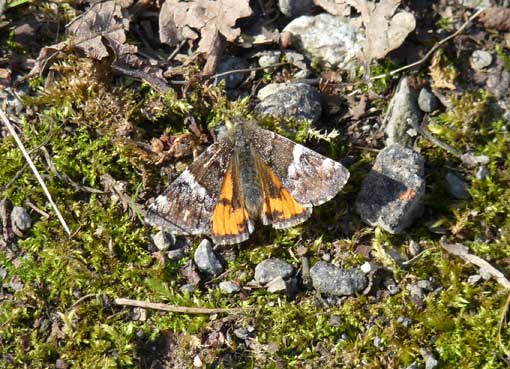
Orange Underwing near Piper Marsh on 30th March 2012 © Helen Womack
Thursday 29th
Ian Heppenstall made a brief visit: There was a male Siskin and possibly a female, mixed with other finches in one of the pines on the edge of Black Carr Wood. Also at the edge of Black Carr Wood, a Treecreeper. Other wildlife included a Weasel on the access track, a small Grass Snake in the centre of the Reserve, a single Orange Underwing moth, again at the edge of Black Carr Wood and various butterflies, including Speckled Wood (Butterfly Alley and Piper Marsh), Orange Tip (Piper Marsh), several Peacock and a couple of Comma.
The daffodils in Black Carr Wood are in flower and Ken Woolley has taken a photo (below). The origin of these plants is uncertain since the plantation only dates back to 1834, although the species is considered to be Wild Daffodil.
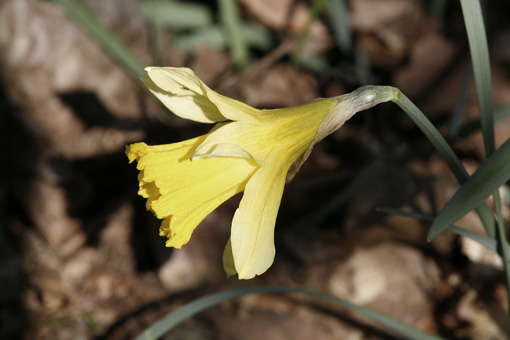
Wild Daffodil ? in Black Carr Wood © Ken Woolley
Wednesday 28th
A Speckled Wood was seen near the iron-railed bridge (R Mokryj). Photos of Orange-tip taken on 26th March and Cowslip yesterday.
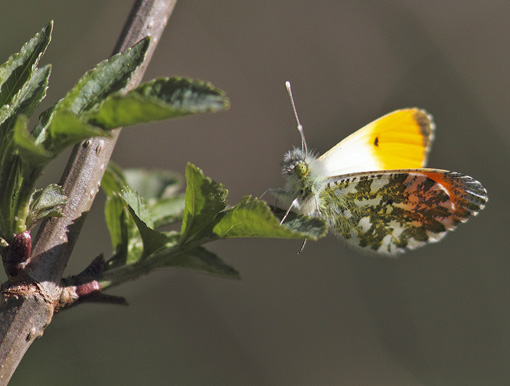
Orange-tip taken at Potteric Carr on 26th March 2012 © Barry Wardley
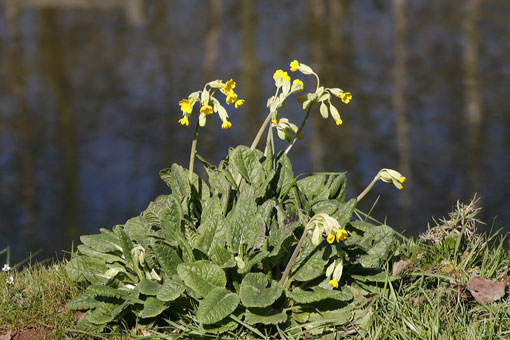
Cowslip on Mother Drain south bank, 27th March 2012 © Ken Woolley
Tuesday 27th
Many butterflies were out in the warm sunshine, including 2 Orange-tip males (R Mokryj); Brimstone 5 male, 2 female; Peacock, Comma and a White sp (P Greaves). In addition, a male Orange-tip was seen yesterday (26th), the first ever March record of this species at Potteric Carr. More Grass Snakes were out, immature and full grown in length. Two jousting buck Roe Deer were caught on
video
(8MB 52 second clip; may take time to load on your player) by Barry Wardley.
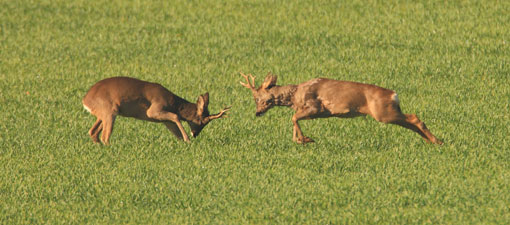
Roe Deer bucks jousting on 27th March 2012 © Robin Mokryj
Derek Bateson: ‘Another glorious spring day which brought out many migrant birds including five Chiffchaff on Loversall Bank. A nice splash of colour were the breaking buds of Field Maple Acer campestre (image), which KW and I both photographed. Bumble Bees of at least three species were prospecting for nest sites, but I only managed the queens of Bombus pascuorum and B. terrestris (images). There were Millipedes and Centipedes aplenty in leaf litter and beneath rotten logs, but no new species were found. Finally, in Loversall Triangle a carpet of moss had produced masses of attractive seed capsules (image) and I am having the species identified by Sorby’s Joan Egan.’

Field Maple buds bursting into leaf, Potteric Carr, 27th March 2012 © Derek Bateson

Bumble Bee Bombus pascuorum , Potteric Carr, 27th March 2012 © Derek Bateson

Bumble Bee Bombus terrestris , Potteric Carr, 27th March 2012 © Derek Bateson

Moss
Funaria hygrometrica
© Derek Bateson
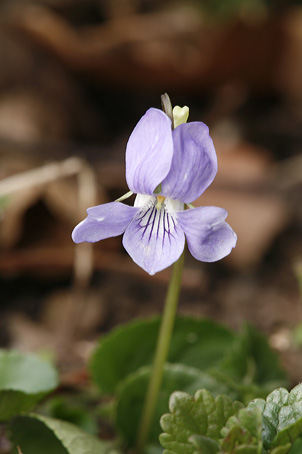
Heath Dog-violet flowering along butterfly alley on 27th March 2012 © Ken Woolley
Sunday 25th
Derek Bateson reports on a sunny spring morning's photographic recording: 'After early fog the day turned out to be quite productive, and my two usual cohorts were elsewhere, so I donned my botanist's hat. First of all the male and female flowers (catkins) of Betula sp caught my eye in the Wardens' Car Park (image). Around the corner near the Pumping Station, the first Primrose Primula vulgaris (image) was showing quite well, covered in dew. Similarly, some more Cowslips P veris (image) had appeared in flower. I then photographed some Sycamore buds (image), White Dead-nettle Lamium album (image), and a Violet Viola sp (image). I am not entering an argument with KW as to which species! Dog’s Mercury Mercuralialis perennis (image) was the last on my plant list for today.
I then turned my attention to the steps over Hawthorn Bank which always at this time of the year provide good shots of the Mining Bee Nomada flava (image). Several of this species were prospecting and then I noticed two entirely different bees, excavating nesting holes. These are pictured (images). At the moment I am unable to name them but have sent images to Dr Michael Archer in York who is one of the leading Aculeate experts in the UK, to give a determination, so watch this space.'
Report by Janet and Ian Heppenstall: 'We paid a visit to Potteric this afternoon and walked around the western end of the reserve. Janet spotted a 3 feet long Grass Snake sunbathing on top of a mound of brash at the western end of Loversall Bank. Butterflies seen included 4 Brimstone, 3 Peacock and 2 Comma. A Weasel was watched on the railway bank opposite Old Eaa Marsh.'


Male and female Birch catkins and Primrose © Derek Bateson


Cowslip and Sycamore buds © Derek Bateson


White Dead-nettle and Violet sp © Derek Bateson


Dog's Mercury and Mining Bee Nomada flava © Derek Bateson

Solitary Mining Bee Andrena clarkella (det. M Archer) © Derek Bateson


Solitary Mining Bee Andrena clarkella (det. M Archer) © Derek Bateson
Saturday 24th
Until 31st March, please send all news and photos to the bird recording team, email address on Bird News page.
Recent additions to this website include a fully revised List of Potteric Carr Flora compiled by Ken Woolley. This PDF can be accessed by going to the Species Lists page and then open the Plants page. Similarly, Derek Bateson has compiled a Hoverfly List for Potteric Carr Nature Reserve, a PDF which can be found by going to the Species Lists page and then opening the Hoverflies page.
When species English names only are given in Wildlife News reports, the Scientific / Latin name can be found in species lists that are accessible from the Species Lists page options. Clocks go forward by one hour early Sunday morning, 25th March, to British Summer Time.
Ken Woolley was out with his camera on Thursday and Friday and has provided a number of images. He recorded 8 Grass Snakes embraced (6 remained when the photo was taken).
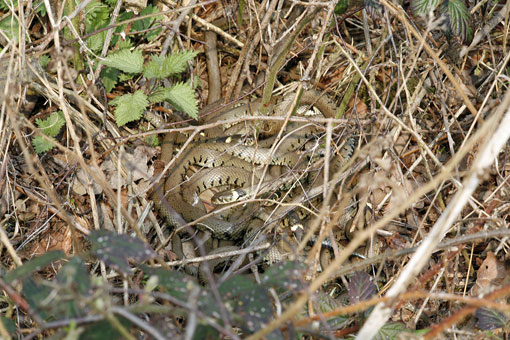
Six Grass Snakes in a mating embrace at Potteric Carr on 23rd March 2012 © Ken Woolley
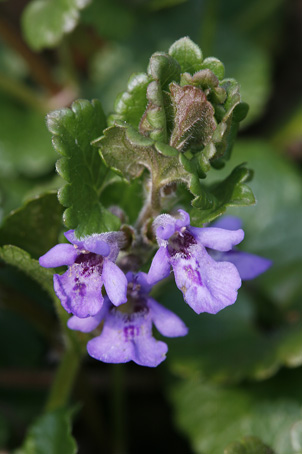
Ground-ivy in flower on 23rd March 2012 © Ken Woolley
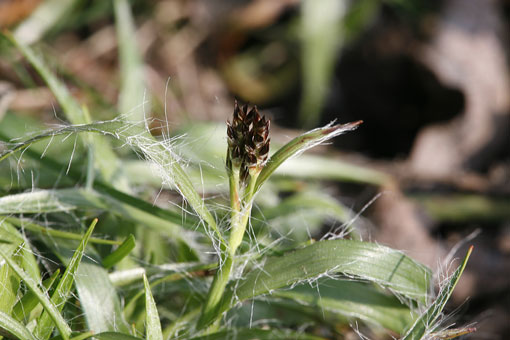
Field Wood-rush at Potteric Carr © Ken Woolley
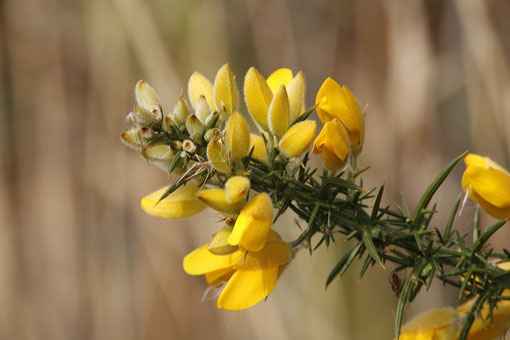
Gorse on 23rd March 2012 © Ken Woolley
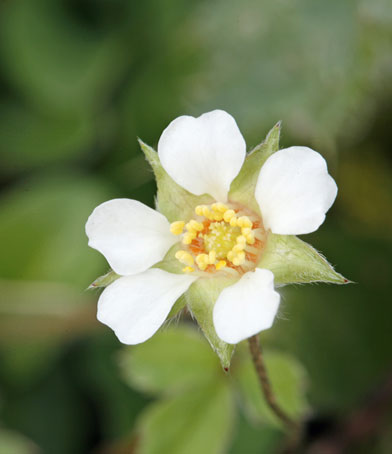
Barren Strawberry flowering on 22nd March 2012 © Ken Woolley
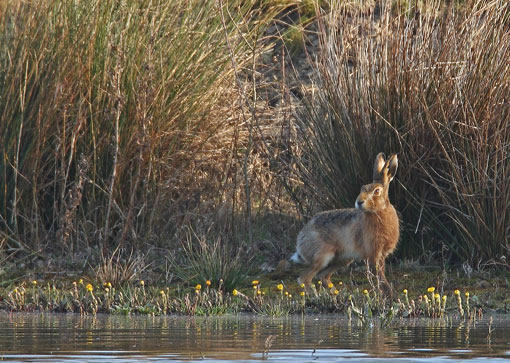
Brown Hare on Huxter Well Marsh, with Colts-foot in flower, 16th March 2012 © Robin Mokryj
Thursday 22nd
I was tempted by the Spring sunshine to visit Potteric this afternoon and made my way over to Huxter Well. No new bird species were noted but I did observe a pair of Redshank Tringa totanus mating on Cell 3b. Plants seen in flower for the first time this year included Wild Strawberry Fragaria vesca on the bank of the Mother Drain east of the Pumping Station and Barren Strawberry Potentilla sterilis in Loversall Triangle. Leaves of Columbine Aquilegia vulgaris were also showing on Hawthorn Bank, south of Duchess Hide. A sizeable group of Glistening Ink Cap Coprinellus micaceous fungi were noted on Hawthorn Bank. Surprisingly, no butterflies were seen (Ian Heppenstall).

Wild Strawberry Fragaria vesca © Allan Parker ARPS
Wednesday 21st
While all the signs of Spring are here, illustrated below by an early emerged Fly sunning itself on a tree trunk , some remnants of Autumn / Winter still linger and the backlit Autumn leaves 'glowing' in the Spring sunshine illustrate the season gone.


Left, Fly species 'sunning' and right, Bramble Rubus fruiticosus backlit leaves both images © Allan Parker ARPS
Late news from yesterday
A Grass Snake Natrix natrix was sunning itself on a bank between Decoy Marsh hide and Old Eaa hide and a second was seen near Hawthorn Bank. A single Cowslip Primula veris was in flower on the Mother Drain bank near the Pumping Station (Ian Heppenstall).
Tuesday 20th
Allan Parker and Ken Woolley report:-
A Stoat Mustela erminea was reported swimming in a pond near the Roger Mitchell Hide (Michael Bird) and a Weasel Mustela nivalis was reported elsewhere on the Reserve (Alan McKee).
Butterfly numbers included nine male and three female Brimstone Gonepteryx rhamni, at least four Peacock Inachis io and a single Comma Polygonia c-album
Two hoverfly, both Eristalis pertinax, were in flight at the start of the Cottage Drain path, our first for the year. Also in this area was what appeared to be a Bee-fly probably Bombylius major . 7-spot Ladybird Coccinella septempunctata were noted in good numbers 'sunning' themselves on a variety of vegetation.
Several Bumble-bee species, including large queens of White-tailed both Bombus lucorum and Bombus terrestris plus Red-tailed Bombus lapidarius , were all busy seeking nesting sites and other bee species included Cuckoo Bee Nomada flava (see image) again prospecting various holes along a sunny bank. A single large queen Common Wasp Vespula vulgaris was also noted.
Common Frog Rana temporaria were still busy in Cottage Drain but their numbers were down to five although the clumps of frog spawn had increased since Sunday
A Leech species (see image) was swimming the the larger of the two 'dragonfly' ponds in Hawthorn Field, the only sign of life noted here since they dried out last year (if anybody out there can come up with a positive ID it would be appreciated).
Coltsfoot Tussilago farfara (see image) , Ground Ivy Glechoma hederacea , Violet Viola species (probably Early dog Violet Viola reichenbachiana) , Dog's Mercury Mercurialis perennis , Dandelion Taraxacum officinale (see image) , Daisy Bellis perennis (see image), Hairy Bittercress Cardamine hirsuta , Lesser Celandine Ranunculus ficaria , Primrose Primula vulgaris , Thale Cress Arabidopsis thaliana (see image), Field Speedwell Veronica persica , Grey Willow Salix cinerea (see image) and Blackthorn Prunus spinosa were all in flower
Glistening Ink Cap Coprinellus micaceaus was noted at least four sites across the Reserve, Scarlet Elf Cup Sarcoscypha austriaca were still present in St Catherine's Copse and behind the seat near the start of the Cottage Drain path and probable Ink Cap Coprinellus impatiens or Fairy Ink Cap Coprinellus disseminatus was photographed by Ken (see image).


Left, Grey Willow Salix cinerea and right, Coltsfoot Tussilago farfara both images © Allan Parker ARPS


Left, Bee Nomada flava and right, Leech species swimming both images © Allan Parker ARPS


Left, Lesser Celandine Ranunculus ficaria and right, probable Ink Cap Coprinellus impatiens or Fairy Ink Cap Coprinellus disseminatus both images © Ken Woolley


Left, Thale Cress Arabidopsis thaliana and right Daisy Bellis perennis both images © Ken Woolley


Left, Dandelion Taraxacum officinale and right, probable Early dog Violet Viola reichenbachiana both images © Ken Woolley
Derek Bateson reports:-
' My first objective today was to check on the mating frogs in Cottage Drain, but early on the sun had not coaxed them from under the weed although I learned that they emerged about 11.45am. Today was certainly a day for butterflies as some five male and three female Brimstone Gonepteryx rhamni were noted by various observers, also at least three Peacock Inachis io plus two others, not identified.
KW and AP went off to Black Carr Field and I explored Hawthorn Bank and was rewarded with a Pine Ladybird Exochomus quadripustulatus (see image) under some bark together with Common Woodlouse Porcellio scaber (see image). Pine Ladybird is rather a misnomer as they are usually found associated with deciduous trees and are harbingers of Spring. Many 7-spot Ladybirds were sunning themselves on Bramble. Most of the woodlice seen recently have been Common Shiny Woodlouse Oniscus aseilus but below is an image of Common Woodlouse Porcellio scaber . Next up was a small clump of Glistening Ink Cap fungus Coprinellus micaceaus (see image), but in quite a dry state. In one of the hides I found what I thought was another Pine Ladybird E. quadripustulatus , but this turned out to be a Harlequin Ladybird Harmonia axyridis f. spectabilis (see image), totally ignoring one of its prey species, a Lacewing Chrysopa perla. The lacewing produced quite a good shot against the light to show wing patterning. Buds of Dog's Mercury Mercurialis perennis were my final shot of the day but I think Allan and Ken have other sightings (see above). Green Woodpecker Picus viridis was ‘yaffling’, and several Chiffchaff Phylloscopus collybita were heard, but only one was seen’


Left, Common Woodlouse Porcellio scaber and right, Glistening Ink Cap Coprinellus micaceaus both images © Derek Bateson


Left, Lacewing Chrysopa perla and Harlequin Ladybird Harmonia axyridis f. spectabilis and right, Pine Ladybird Exochomus quadripustulatus © Derek Bateson

Lacewing Chrysopa perla © Derek Bateson
Sunday 18th
Ken Woolley and Allan Parker report:-
Just two of us set off this morning (it would appear that Derek had been confined to barracks). After the Hazel Corylus avellana, Alder Alnus glutinosa catkins and the Goat Willow Salix caprea flowers (which had suffered badly with the heavy over-night rain) it was the turn of the Silver Birch Betula pendula catkins to appear (see image). Blackthorn blossom (see image) was also present at various sites along Loversall Bank, Willow Bank and Cottage Drain. Good numbers of queen bumble-bee of at least three possibly four different species were active. Seventeen leaf florets of Bee Orchid Ophrys apifera were noted at the usual site. Eight fruiting bodies of Scarlet Elf Cup Sarcoscypha austriaca were found in St. Catherine's Copse. Cottage Drain had at least a dozen Common Frog Rana temporaria and there were a similar number of frog spawn clusters in the weed (see images). Ground-ivy Glechoma hederacea has started flowering and a Orange Underwing Archiearis parthenias was seen flying alongside the Big Hedge by Ken Woolley, DC, S & RB).

Blackthorn Prunus spinosa blossom © Allan Parker ARPS


Left, Silver Birch Betula pendula catkins and right, Scarlet Elf Cup Sarcoscypha austriaca both images © Allan Parker ARPS


Left, Common Frog Rana temporaria and right, frog spawn © Ken Woolley
Saturday 17th
An American Mink Mustela vison was running along ring main from Roger Mitchell Hide being chased by a flock of Black-headed Gull Larus ridibundus . Twenty plus Common Frog Rana temporaria in a Cottage Drain weed patch, all busy!! Pair of Common Toad B. bufo seen by the path at slope end of Hawthorn Bank, couldn't wait to get into water!!! (Michael Bird / Brian Buckle).

Common Toad Bufo bufo mated pair © Allan Parker ARPS
Thursday 15th
Today is the SEVENTY FIFTH birthday of 'Grumpy One' aka John Hancox, congratulations from all the website team et al. The new slimline John came out of his winter hibernation last Tuesday and was initially recorded by Michael Bird who reported ' A very early sighting of summer visitors to PC were seen today near Old Eea Marsh. They (John and Maureen) had lost a considerable amount of weight during the lean winter months but looked very fit and healthy considering John will be 75 on Thursday.
My reply to Michael was, 'The Three Musketeers also noted both John and Maureen heading west along Loversall Bank but the speed of the new slimline versions didn't allow us to catch-up'. Again all the best John. (Allan Parker et al)
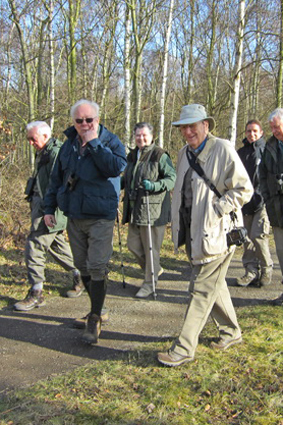
'Grumpy One' John Hancox (right) alongside 'Doctor Death' Derek Bateson © Dave Carroll
Tuesday 13th
On a cool grey morning we set off along Loversall Bank where Blackthorn Prunus spinosa (see image) was in flower but not much else was about except foe several White-tailed Bumble-bee Bombus lucorum and at least three Red-tailed Bumble Bee Bombus lapidarius . in the Loversall Field area Goat Willow Salix caprea was in full flower (see images). After photographing the Goat Willow S. caprea in Loversall Field we returned back along Loversall Bank by this time we had lost Derek. Here Barry Wardley told us about a couple of fruiting bodies of Scarlet Elf Cup Sarcoscypha austriaca (see image) at a new site behind the seat at the junction of the Cottage Drain path. This decided us to check on the usual site for this fungi and we were rewarded with some twenty plus fruiting bodies including the largest one that Ken and I have seen, some three inches across (see image). This fungi is very late this year being some four to six weeks later than a 'normal' year. We also found under a piece of slate a tiny Hairy Snail Trichia hispida / Trochulus hispidus (see image) along with a tiny Harvestman species that escaped having its image recorded. Gorse Ulex europaeus and Coltsfoot Tussilago farfara were both in flower along the path past Old Eaa. (Ken Woolley Allan Parker).

Blackthorn Prunus spinosa blossom © Allan Parker ARPS


Left, Goat Willow Salix Salix caprea male flowers and right, female flower © Allan Parker ARPS

Scarlet Elf Cup Sarcoscypha austriaca near Cottage Drain © Allan Parker ARPS


Left, Scarlet Elf Cup Sarcoscypha austriaca at usual site and right, Hairy Snail Trichia hispida / Trochulus hispidus both images © Allan Parker ARPS
Derek Bateson reports:-
'The three Musketeers set off along Loversall Bank, but first pausing to image Blackthorn Prunus spinosa, also Alder Alnus glutinosa , and later, Dog’s Mercury Mercurialis perennis (see image) which wasn’t completely in flower and the light was poor. Goat Willow Salix caprea, also proved popular, but I was interested in looking for invertebrates. Passing Loversall Delph, AP/KW noticed literally dozens of dead Great Pond Snail Lymnaea stagnalis (see image). This is due to the Delph being allowed to dry out, and it badly needs topping up, to allow Great Crested Newt, Triturus cristatus and Toad, Bufo bufo to breed. At the far end of Loversall Bank I decided to inspect dead Hogweed stalks from last year and I was quickly rewarded with a Hairy Snail Trochulus hispidus / Trichia hispida (see image), an Earwig Forfica auricularia (see image), and a small Slug (probably Tandonia sowerbyi per Robert Cameron), being inspected by a Club-tailed Snake Millipede Cylindroiulus punctatus (see image). On my return along Loversall Bank I gently turned over a dead and rotting log to find a small colony of Ants, species not determined, but I have asked Steve Price for help (see image), (probably Myrmica scabrinodis per Steve). After a short break AP and KW went off towards Childers Wood, so watch this space’ (see above).

Dog’s Mercury Mercurialis perennis © Allan Parker ARPS


Left, Great Pond Snail Lymnaea stagnalis empty shells and right, Hairy Snail Trochulus hispidu / Trichia hispida both images © Derek Bateson


Left, Earwig Forfica auricularia and right, Slug probably Tandonia sowerbyi being inspected by Club-tailed Snake Millipede Cylindroiulus punctatus, both images © Derek Bateson

Ants probably Myrmica scabrinodis © Derek Bateson
Monday 12th
Reed bed cutting and burning was taking place on the Reserve today and the images below by Michael Rushton illustrate this.


Reed bed cutting and burning, both images © Michael Rushton
Sunday 11th
A Comma Polygonia c-album was feeding on Blackthorn Prunus spinosa blossom along the Access Track. Several White-tailed Bumble Bee Bombus lucorum were noted around the Reserve including along Cottage Drain. Several Common Earwig Forficula auricularia and a couple of small Millipede were found inside some dead umbellifer stems. (Ken Woolley Allan Parker).

Bramble Rubus fruiticosus leaves © Allan Parker ARPS
Below are some images taken today. The beetle on Coltsfoot
Tussilago farfara
was along Cottage Drain as was the Bramble leaves. The Common Frog
Rana temporaria
and the Common Field Speedwell
Veronica persica
were on the rough ground and path near the Pumping Station. Again, there were lots of 7-spot Ladybirds, Millipedes and Woodlice to be found under bark or moss (Derek Bateson)

Common Frog Rana temporaria © Derek Bateson


Left, Coltsfoot Tussilago farfara with small Beetle and right Bramble Rubus fruiticosus emerging leaves © Derek Bateson

Common Field Speedwell
Veronica persica
© Derek Bateson
Saturday 10th
Common Field Speedwell Veronica persica was in flower all over the place (Michael Bird)
Three Roe Deer Capreolus capreolus were on Willow Bank early this morning ( Dave Forbes)
REPORT ON MOTH RECORDING – FRIDAY NIGHT, 9 MARCH, 2012
The weather on Friday night was very mild – 11degrees – and so the moth trap came out again and the result was a bumper catch of around 150 moths, comprising 22 species. The warmest nights are when the interesting species can turn up and so it proved, with another new moth for the reserve. Amblyptilia acanthodactyla is a small ‘Plume’ moth whose larvae feed upon the flowers and flower buds of a wide range of herbaceous plants. It has been widely recorded in Yorkshire in recent years, although always in small numbers and is a good find. Another interesting species was Caloptilia populetorum , first discovered on the reserve in 2010 when 3 were recorded. The latest record strongly indicates breeding on the reserve. Away from Potteric, it has only been found at two other locations in Yorkshire as single examples. The other moths recorded were mostly ones to be expected at this time of year and included, amongst others, several handsome Oak Beauty Biston strataria , Satellite Eupsilia transversa , Red Chestnut Cerastis rubricosa , Yellow Horned Achlya flavicornis and various Orthosia species ( Drabs and Quakers).
Ian Heppenstall Moth Recorder


Left, Engrailed Ectropis bistortata and right Yellow-horned Moth Achlya flavicornis both images © Ken Woolley


Left, Twin-spotted Quaker Orthosia munda and right, Oak Beauty Biston Strataria both images © Ken Woolley
Wednesday 7th
This image below of a Red Admiral Vanessa atalanta was taken on Rossington Bank near the 'Iron Bridge' on the Reserve last Monday 5th. Does this extremely early record of what is a migratory species which does not normally over winter this far north in the UK suggest an over wintering individual? The previous earliest record for the reserve is probably as late as May.
There appears to have been a few early records in Yorkshire this year the earliest being 9th January (see the Yorkshire Butterfly Conservation Branch website).

Red Admiral Vanessa atalanta © Nigel Clarke
Below is a larva, probably a beetle, which I photographed under the bark of a dead Oak log on Tuesday 28th February. I have tried to ID it and it has puzzled three other local experts. I have now sent details to the Natural History Museum in London to see if they can suggest anything.
Today I had an e-mail from Howard Mendel at the London Natural History Museum with his identification. It is the larva of one of our largest Click Beetles Stenagostus rhombeus (Elateridae) at the northern limit of its range in Britain. Interestingly enough, last year, not far from the same site, I found, and photographed the rather large adult of this species. (See images for comparison). Again, I had to go to the NHM for identification, as it didn’t fit my keys (Derek Bateson).


Click Beetle Stenagostus rhombeus left larvae and right adult beetle © Derek Bateson
Tuesday 6th
This morning a dog Fox Vulpes vulpes was on Piper Marsh. Seen from Willow Bank this afternoon were two Roe Deer Capreolus capreolus in Loversall Carr fields next to the wood. Early this morning three Musketeers were seen leaving no log un-turned in Black Carr Field in search of the ????? (Michael Bird).
Derek Bateson reports:-
'Today the three Musketeers were split into two as Ken was late on parade. I wandered off and photographed some frosty thistles. Ken, Allan and I went to Black Carr Field basically for me to rediscover an interesting beetle larva, unfortunately without success. However, shoots of Elder Sambucus niger, showed that Spring is on the way (see image). I then started looking at rotten logs and soon found more Flat-backed Millipede Polydesmus species. Under bark from the same log were Snake Millipede Cylindroiulus punctatus, then a dormant spider Amaurobius species probably similis per Richard Wilson who I contacted for confirmation in Tenerife! (see image). Another log produced a lovely Ground Beetle with chestnut legs and mandibles, Leistus species (see image). Allan and I then photographed a selection of some twenty-five 7-spot Ladybird Cochinella septempunctata (see image), all enjoying the warm spring sunshine. On the way back to the Field Centre we heard Green Woodpecker and AP spotted a Kingfisher on Mother Drain and a small flock of Long-tailed Tit, and possibly a Song Thrush.
In the afternoon Ken and myself, (Derek's morning only pass had run out), set off round the western end of the Reserve past Old EAA and Decoy Marsh where several Coltsfoot Tussilago farfara (see image) , lots of Gorse Ulex europaeus and a single Lesser Celandine Ranunculus ficaria were all in flower. Near Decoy Marsh hide Blackthorn Prunus spinosa was mostly still in tight bud but along the path between Decoy Lake Hide and the footbridge it was in full flower (see image) . Elsewhere Goat Willow Salix caprea was in flower along with Scots Pine Pinus sylvestris (see images).
Several queen White-tailed Bumblebee Bombus lucorum were in flight searching for nest sites and on sun facing Birch trunks small unidentified flies were warming themselves (Allan Parker Ken Woolley).

7-spot Ladybird Cochinella septempunctata 'sunning' © Allan Parker ARPS

Snake Millipede Cylindroiulus punctatus © Derek Bateson


Left, Spider Amaurobius species probably similis and right, Ground Beetle Leistus species, both images © Derek Bateson


Left, Coltsfoot Tussilago farfara and right, Goat Willow Salix caprea , both images © Ken Woolley

Scots Pine Pinus sylvestris © Ken Woolley


Left, Elder Sambucus nigra leaf buds and right, Blackthorn Prunus spinosa flower both images © Allan Parker ARPS
Saturday 3rd
The first Blackthorn Prunus spinosa flowers were showing along the path from the entrance, together with leaves of Hawthorn Crataegus monogyna and Elder Sambucus nigra (Ian Heppenstall).
Also in flower were Lesser Celandine Ranunculus ficaria along the path from Old Eea (BGAB/MAB).

Blackthorn Prunus spinosa blossom © Allan Parker ARPS

Lesser Celandine Ranunculus ficaria © Allan Parker ARPS
Friday 2nd
In response, Derek would like to thank all those volunteers who sent cards, e-cards and e-mails on his birthday today. Hopefully he can continue to rely on two-legged support and three-legged tripods, to keep him on the straight and narrow.
Chris Measures visited reserve yesterday March 1st and reports:
About 1130 hours a single Peacock Inachis io at Piper Marsh. In flight and then settled on mud directly in front of hide.
1200 hours two Brown Hare Lepus capensis running on bank together in centre of Huxter Well Marsh.
Around 1300 hours a Fox Vulpes vulpes on same bank searching for food. No ducks on bank but they were small groups nearby on water and on islands. Interestingly Teal Anas crecca and Mallard Anas platyrhynchos gathered much closer in one large flock by the side of bank within a few feet of the Fox Vulpes vulpes as it came down the bank into the reeds at water's edge; they seemed to be drawn to it, maybe to keep an eye on it, rather than keeping well away.

Peacock Inachis io © Allan Parker ARPS

Fox Vulpes vulpes © David Roberts
Derek Bateson, one of the main contributors to the Wildlife Page, is SEVENTY NINE today so we wish him a very HAPPY BIRTHDAY and long may his tripod continue to keep him upright, all the best Derek (Allan Parker, Ken Woolley et al).

Derek Bateson in action © Ken Woolley
As far as wildlife goes, temperatures reached 16ºC this afternoon prompting the flight of Brimstone (willow Bank), Small Tortoiseshell (seen from Roger Mitchell Hide) and Peacock butterflies. Photographers had 4 Roe Deer at Piper Marsh (Rob Mokryj) and Hare at Huxter Well Marsh (Pete Greaves, image). A Toad was on the path at St Catherine's Field. Ken Woolley has compiled a new list of Potteric Carr flora which can be found on the Plants page via Species Lists page of this website.
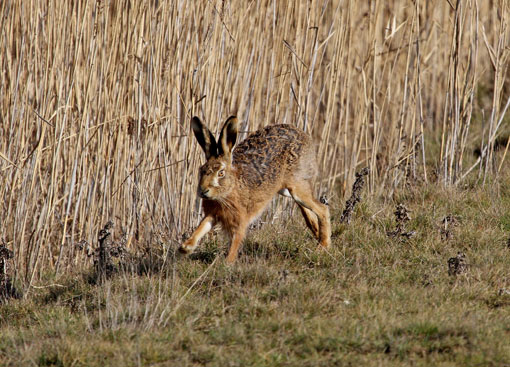
One of two Hares chasing along a Huxter Well embankment near Roger Mitchell Hide, 1st March 2012 © Pete Greaves
February 2012
Tuesday 28th
Four Roe Deer Capreolus capreolus were on the Mother Drain bank between Hawthorn Bank bridge and 'Iron' bridge. Toad Bufo bufo were on the move along Cottage Drain, one seen next to the path and several in the drain (Michael Bird).
Derek Bateson reports:-
'Time was limited today due to a scheduled meeting, but the three of us set off early for Black Carr Field, but Allan and Ken decided to botanise and they both imaged emerging Hawthorn Crataegus monogyna leaves (see image). I continued down into Black Carr Field where I started to investigate some rotten logs. First up was a small snail (see image) which was not determined although close by there were others of a different species Discus rotundatus. Under some bark was a bright yellow centipede, probably Necrophloeophagus flavus (see image). Other logs produced many woodlouse (see image), possibly Oniscus asellus together with Club-tailed Snake Millipede Cylindroiulus punctatus (see image) and Flat-backed Millipede Polydesmu s species and another, probably Polydesmus angustus (see images). Whilst photographing these, I noticed a tiny (2-3mm), insect creep into the picture, so I took an image and this is possibly a Thrips (see image), but impossible for me to determine. Turning over logs usually produces moulds and fungi and today was no exception (see image).


Left, Hawthorn Crataegus monogyna fresh leaves and right, Moss Polychtricum commune both images © Allan Parker ARPS

Woodlouse species possibly Common Shiny Woodlouse Oniscus aseilus © Allan Parker ARPS


Left, Unidentified snail and right possible Thrips species, both images © Derek Bateson


Left, Club-tailed Snake Millipede Cylindroiulus punctatus and right, probably Millipede Polydesmus angustus © Derek Bateson


Left, Centipede probably Necrophloeophagus flavus and right, unidentified fungal growth, both images © Derek Bateson
Sunday 26th
The three of us set off with signs of Spring much in evidence. Hazel Corylus avellana along with Alder Alnus glutinosa were in flower (see images). A Willow Salix species was also noted coming into flower near the Field Centre. Ken and myself soon lost Derek who only made it half way along Loversall Bank and was last noted turning logs over and photographing a Black Snake Millipede Tachypodoiulus niger and other millipede species (see images). Ken and myself continued past Loversall Delph and then along Willow Bank, through St. Catherine's Copse and along Cottage Drain.
Several Coltsfoot Tussilago farfara were noted along Willow Bank and at the top of the Cottage Drain path near the 'underbridge' over Mother Drain.
There was little else to report, on a sunny Spring like day, except for an unidentified Bumble Bee species in flight along Willow Bank and a Primrose Primula vulgaris with just a single flower bud showing (see image). The large shoal of small fish were still in Mother Drain alongside the 'underbridge'.
(Allan Parker, Derek Bateson and Ken Woolley).


Left, Alder Alnus glutinosa male catkins and female flowers and right, Coltsfoot Tussilago farfara © Allan Parker ARPS


Hazel Corylus avellana left, female flower and right, male catkins © Allan Parker ARPS

Primrose Primula vulgaris © Ken Woolley

Black Snake Millipede Tachypodoiulus niger © Derek Bateson


Left, Millipede Brachydesmus superus , centre and right Millipede Polydesmus species , all © Derek Bateson
MOTH TRAPPING REPORT FOR THURSDAY NIGHT, 23 FEBRUARY, 2012
Milder conditions prompted me to trap again on Thursday night, 23 February. This proved to be far more productive than the previous week, with 15 species recorded and good numbers of several species, for example 12 Chestnut Conistra vaccinii and 9 Pale Brindled Beauty Phigalia pilosaria. An unexpected moth for this time of year was a single Water Carpet Lampropteryx suffumata , more typically on the wing in April and May, perhaps an indication that another early Spring is on the way.
Other species recorded included Ypsolopha ustella, Agonopteryx heracliana, Agonopteryx alstromeriana, Mompha jurassicella, Tortricodes alternella, Acleris notana, March Moth Alsophila aescularia, Spring Usher Agriopis leucophaearia, Dotted Border Agriopis marginaria, Engrailed Ectropis bistortata, Early Moth Theria primaria and Satellite Eupsilia transversa.
Ian Heppenstall Moth Recorder

March Moth Alsophila aescularia © Allan Parker ARPS

Satellite Eupsilia transversa © Allan Parker ARPS
Saturday 25th
A dozen or so Roe Deer
Capreolus capreolus
in the fields alongside Willow Bank path. I could hear a male barking in the woods (Josh Rowley).
Thursday 23rd
A tiny bat presumably a Pipistrelle Pipistrellus pipistrellus, was hawking along Hawthorn Bank at 6.30am this morning. Very early in the year for bats, no doubt it was activated by the very mild weather (Tony Elliott).
Four Roe Deer Capreolus capreolus were near pump on Huxter Well Marsh (Michael Bird).
Two species of butterfly were out in the sunshine, Peacock and male Brimstone near Decoy Marsh. A Weasel was along the path between Balby Carr Copse and Decoy Marsh (Dave Carroll).
Tuesday 21st
On a fine sunny Spring like day seven of us took a walk round the Reserve in the company of Ian Jelley the new Reserves Manager for South-west Yorkshire.
More Coltsfoot Tussilago farfara was noted in flower on Huxter Well Marsh and also along Cottage Drain path. Both male and female flowers were noted on Hazel Corylus avellana and Honeysuckle Lonicera periclymenum had burst into leaf.
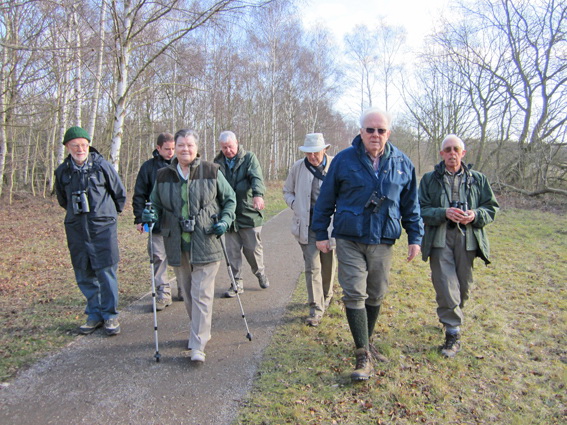
Volunteers group with Ian Jelley © Dave Carroll
Sunday 19th
Derek Bateson reports:-
'The three Musketeers set off on this lovely sunny, but cold morning to look for more specimens of Scarlet Elf Cup Sarcoscypha austriaca (see image). Despite the dry weather, some 15-20 specimens were seen in the usual location but all were a little leathery and not as colourful as usual. They certainly prefer damper conditions and because leaves have not rotted down this year, probably many specimens were concealed, and thus overlooked. On an adjoining fallen tree, I noted a very old specimen of Hoof Fungi Fomes fomentarius (see image). This shows some attractive cracking and colouration and it can be seen that the underside has been attacked by another fungus. The eagle-eyed may be able to spot a small insect on one of the blackened cracked areas. Blushing Bracket Daedaleopsis confragosa was also seen here (see images showing variations) and AP spotted a tiny annelid worm (see image), which is impossible to determine without microscopical examination. Several of the fallen tree trunks had Lichen growing on them (see image). Not much else was seen except a small flock of Long-tailed Tit, plus a Goldfinch, in Childers Wood spotted by AP. A Great Spotted Woodpecker was drumming and Great Tit was quite vocal, heralding the Spring’


Scarlet Elf Cup Sarcoscypha austriaca © Derek Bateson


Left, Hoof Fungi Fomes fomentarius and right, Annelid Worm species both images © Derek Bateson


Blushing Bracket Daedaleopsis confragosa left image © Ken Woolley and right image © Allan Parker ARPS

Lichen species © Allan Parker ARPS
During our afternoon birding walk (see bird page) around Huxter Well Marsh Ken Woolley and myself found a good number Coltsfoot Tussilago farfara in flower alongside the path next to the Ring Main along with several tiny flowers of a Buttercup species.
On our return standing on the under-bridge looking in Mother Drain we noted a large shoal, numbering several hundred, of small fish about 3 to 4 inch in length. The species wasn't determined but there is no wonder the Kingfisher spends a lot of time in this area (Allan Parker).

Coltsfoot Tussilago farfara © Allan Parker ARPS
Saturday 18th
MOTH TRAPPING REPORT FOR FRIDAY, 17 FEBRUARY
The first moth trapping session of 2012 took place on Friday night, 17 February. The results were rather disappointing, with only 5 species recorded: Tortricodes alternella, March Moth Alsophila aescularia, Spring Usher Agriopis leucophaearia , Pale Brindled Beauty Phigalia pilosaria and Chestnut Conisra vaccinii. The recent cold snap appears to have set back emergence dates of some of the late winter species, such as Drabs and Quakers Orthosia ssp. We now need a settled spell of mild weather to hasten the appearance of these, and other seasonal species.
Ian Heppenstall Moth Recorder.

Pale Brindled Beauty Phigalia pilosaria melanistic form © David Carroll

Spring Usher Agriopis leucophaearia © David Carroll
Thursday 16th
Below is a close-up of one of the Snowdrop Galanthus species in Black Carr Wood taken by Ken Woolley last Tuesday. Unfortunately as Derek has already said they appear to be getting somewhat smothered by Bramble .

Snowdrop Galanthus species © Ken Woolley.
Tuesday 14th
Derek Bateson reports:-
'Only one Musketeer was on the early morning parade, and my intention was to seek out the snowdrops in Black Carr Wood. There are usually three, maybe four clumps, but even with the help of Dave Carroll and Sue Bird, we only found one clump although somewhat later I found a second, but this like the others was largely crowded out by Bramble. These Snowdrop Galanthus species. (see images) were planted I understand in 1992. Close by was a dead tree which when I stripped back some bark, revealed the black rhizomorphs of Honey Fungus Armillaria mellea (see image), which had obviously killed the tree. Looking around I spotted some patches of black fungi on a branch which I though initially were Jews’Ear but didn’t seem quite right. I sent two images to Steve Clements who quickly came back to me to say they were a similar species, but in fact were examples of Witches’ Butter Exidia glandulosa (see image). This is, as far as I am aware, another new species for the Reserve.
On the way back to the Field Centre I noted some very small moss colonies on an ash trunk (see image), but as bryophytes are not my strong point, I have asked Joan Egan, the Sorby Recorder for help. (Joan Egan thinks the moss is Orthotrichum affine which is often found in isolated clumps on Ash trees).
I understand from Ken Woolley that he found several specimens of of Scarlet Elf Cup Sarcoscypha austriaca at the usual site (see images)’


Snowdrop Galanthus species both images © Derek Bateson .


Left, Honey Fungus Armillaria mellea rhizomorphs and right, Witches’ Butter Exidia glandulosa both images © Derek Bateson

Moss Orthotrichum affine © Derek Bateson


Scarlet Elf Cup Sarcoscypha austriaca © both images © Ken Woolley
Sunday 12th
Dale Bentham took a photo of one of the Foxes visiting Piper Marsh yesterday. Since low water levels there have been frozen, Fox behaviour has regularly been observed from the hide in daytime.
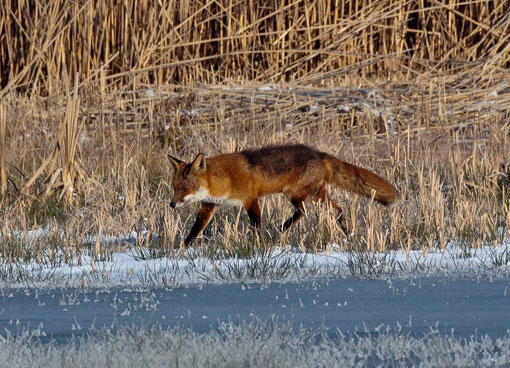
Fox at Piper Marsh on 11th February 2012 © Dale Bentham
Saturday 11th
There have been two or three sightings of Weasels, much smaller than Stoats, on the Reserve in the past two weeks, which is unusual. So, for Tony McCormick to take a photograph of one today is remarkable and continues the recent run of elusive mammal images taken at Potteric Carr this month.
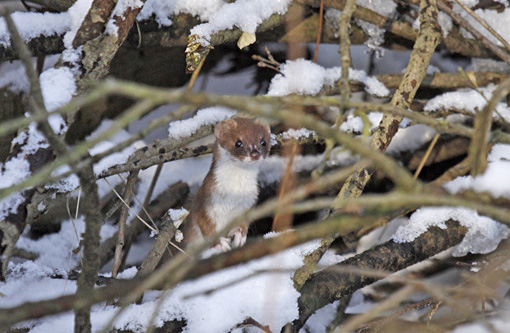
Weasel at Corbett Wood on 11th February 2012 © Tony McCormick
Friday 10th
Animal tracks identified in the snow included Fox, Roe Deer and Rabbit. Two photos of Bank Vole in the snow at Potteric Carr today where taken by Glyn Hudson. This small mammal was probably foraging for spilt seeds from the bird tables at Willow Pool.
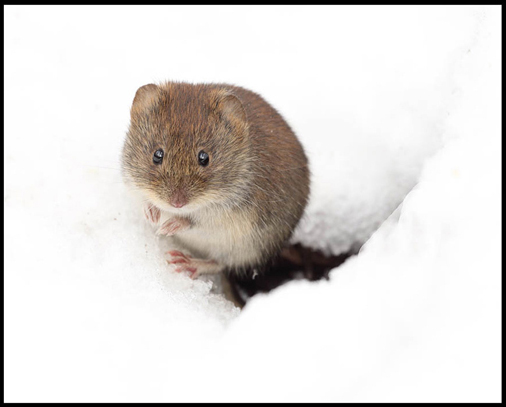
Bank Vole in front of Willow Pool Hide on 10th February 2012 © Glyn Hudson
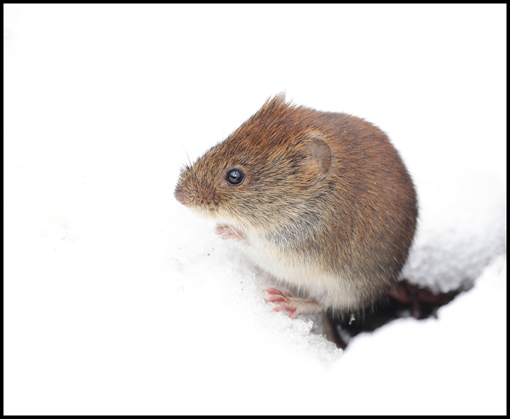
Bank Vole foraging in front of Willow Pool Hide on 10th February 2012 © Glyn Hudson
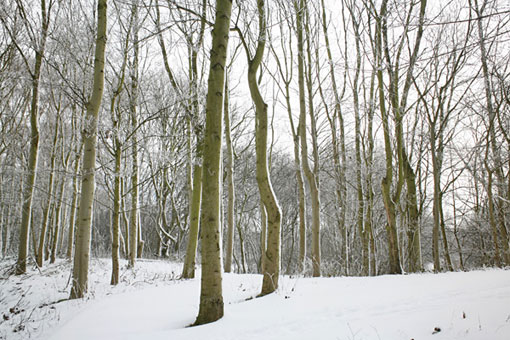
Hawthorn Bank above Hawthorn Field last Sunday © Ken Woolley
Thursday 9th
The wintry scene at Potteric Carr on Sunday was photographed by Ken Woolley.
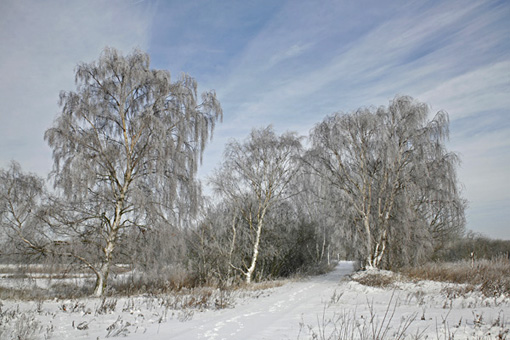
The path between East and West Scrape looking N on 5th February 2012 © Ken Woolley
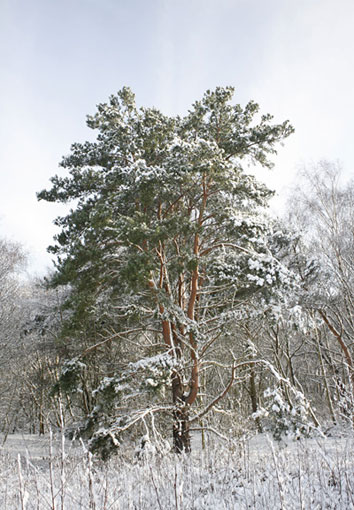
One of the pine trees in Black Carr Field, 5th February 2012 © Ken Woolley
Tuesday 7th
When a Fox appeared on the ice at Piper Marsh carrying at Coot, Sue and Brain Trout where both in the hide with their cameras to capture the moment (photos below).
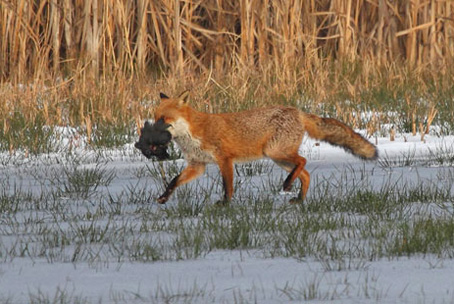
Fox carrying a Coot on Piper Marsh, 7th February 2012 © Brian Trout
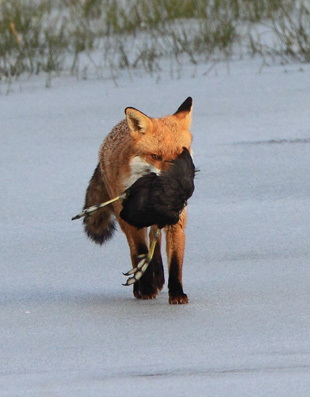
Fox carrying a Coot on Piper Marsh, 7th February 2012 © Sue Trout
Monday 6th
Photos today of two Potteric Carr carnivores, Mink, photographed by Barry Wardley, and Fox at Piper Marsh taken by Robin Mokryj.
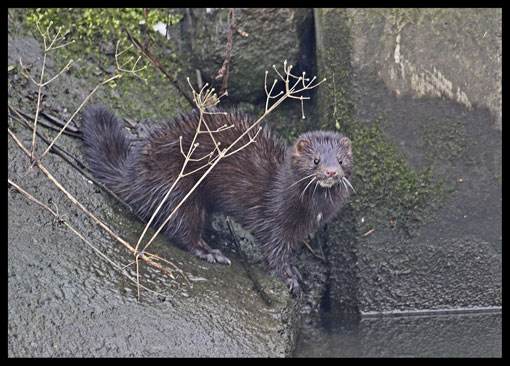
Mink at the IDB pumping station on 6th February 2012 © Barry Wardley
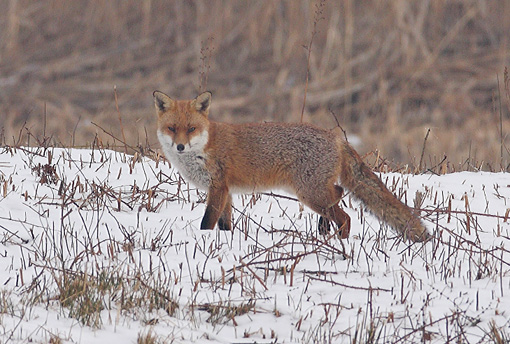
Fox at Piper Marsh today, 6th February 2012 © Robin Mokryj
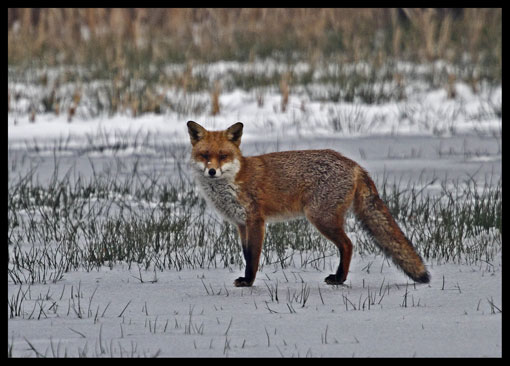
Fox at Piper Marsh today, 6th February 2012 © Barry Wardley
Saturday 4th
This Fox was in a hurry at a frozen Huxter Well Marsh.
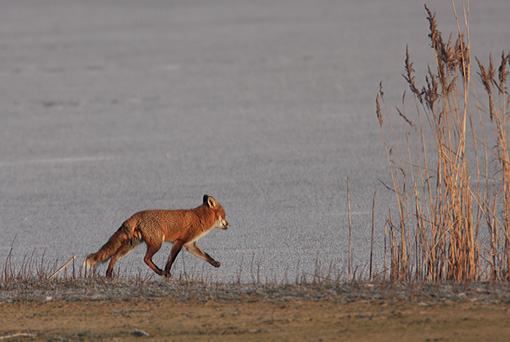
Fox running across Huxter Well Marsh on 4th February 2012 © Robin Mokryj.
Friday 3rd
6 Roe Deer Capreolus capreolus were on Willow Bank blue path and 3 Foxes rested on the Piper Marsh islands in the morning (C Bailey).
January 2012
Tuesday 31st
3 Roe Deer Capreolus capreolus ran across Huxter Well in the morning.
Monday 30th

Black Spleenwort Asplenium adiantum-nigrum , Hawthorn Bank above Hawthorn Field. Taken yesterday © Ken Woolley.
Sunday 29th
Derek Bateson reports:
‘Two of the Three Musketeers decided on birding and looking for the elusive Bittern today so I decided to look for some female Hazel flowers Corylus avellana (image) near the Field Centre. These are tiny, and somewhat difficult to find, looking like tiny crimson sea anemones emerging from a bud. These are a little late and emerged ten days after the male catkins first appeared (I have attached an image for comparison, but the images are not to scale). Lichens seem to be proliferating around the Reserve due to the clean air and I was attracted to this group of developing colonies covered in frost, probably Xanthorina and Parmelia sp. (image). Birch Mazegill Lenzites betulinus is one of the fungi now appearing regularly and these two images show both rosette and bracket forms (images).
As it was extremely cold, I decided to call it a day.’
Other reports today included 2 Roe Deer
Capreolus capreolus
on Piper Marsh and a Weasel performing in front of Decoy Marsh Hide.

Frosted lichen colonies probably Xanthoria and Parmelia sp. © Derek Bateson.


Hazel catkin (male) Corylus avellana left and Birch Mazegill Lenzites betulinus © Derek Bateson.

Hazel Corylus avellana female flower © Derek Bateson.

Birch Mazegill
Lenzites betulinus
© Derek Bateson.
Saturday 28th
Ken Woolley found some twenty or thirty leaves fully open on a Hawthorn Crataegus monogyna near the Decoy Marsh boardwalk, following which he went into landscape mode see images of Huxter Well Marsh below.

Huxter Well Marsh Cell 2A looking east © Ken Woolley.

Huxter Well Marsh central grassland area © Ken Woolley.
2 Foxes ran across the Central Grassland, one chasing the other. They must have been going full speed and ran until out of view towards the motorway bridge near Loversall Fields. Perhaps two males or maybe a male chasing a female? (S & R Bird).
Friday 27th
There were five Roe Deer Capreolus capreolus in Black Carr Field this morning (Glyn Hudson).
Thursday 26th
Dave Carroll reports:-
I had a Stoat Mustela erminea near the Division Drain wooden bridge at Loversall Field and a Frog Rama temporaria on the footpath through St Catherine's Copse.
Saturday 21st
A nice rich coloured Blushing Bracket Daedaleopsis confragosa was photographed in Corbett Wood and a very early flowering (1st for the year) Coltsfoot Tussilago farfara was along the Green Walk near Old Eaa Hide. (Ken Woolley).

Blushing Bracket Daedaleopsis confragosa © Ken Woolley.

Coltsfoot Tussilago farfara © Ken Woolley.
Thursday 19th
Steve Clements a local fungi expert was on the Reserve today and below are some of the images he recorded. Steve's fungi foray resulted in several new species for the Reserve.


Smoky Bracket Bierkandera adusta left, dark form and right, pale form © Steve Clements.

Ochre Cushion Hypocrea pulvinata © Steve Clements.


Left, Slime Mold Trichia species and right, Mucilago crustacea © Steve Clements.
A single Hare seen bounding about on Huxter Well Marsh's Cell 3b. (Ian Heppenstall).
Wednesday 18th
More images from yesterday this time from the camera of Ken Woolley. The hoar frost ice crystals were on a Birch Betula pendula twig on Black Carr Field, the frosted Bramble Rubus fruiticosus leaves were along the path down to the same area, the Slime Mold Mucilago crustcea fungi was just off Loversall Bank on the minor path to Loversall Delph and adding a splash of colour the Water Fern Azolla filiculoides and Least Duckweed Lemna minuta , frozen in a layer of ice, were on Willow Marsh.

Hoar frost ice crystals on a Birch Betula pendula twig © Ken Woolley.


Left, frosted Bramble Rubus fruiticosus leaves and right, Slime Mold Mucilago crustcea fungi © Ken Woolley.

Water Fern Azolla filiculoides and Least Duckweed Lemna minuta © Ken Woolley.
Tuesday 17th
On a very cold frosty day but with the sun shining Derek, Ken and myself setoff at Ken's instigation for Black Carr Field. The grasses and thistles covered in hoar frost were quite spectacular (see images). By 10-20 am Derek had had enough and returned to the Field Centre.
Ken and myself went to check along Hawthorn Bank which had just a few frosted covered fungi these included Birch Mazegill Lenzites betulinus on a Silver Birch Betula pendula stump (see image) and also Velvet Shank Flammulina velutipes again on a Silver Birch Betula pendula stump.
By late morning it was somewhat warmer but it had started to cloud over and the light had 'gone'. Below are some images of the frosted flora.


Hoar frost ice crystals on dead Thistle © Allan Parker ARPS

Hoar frost ice crystals on dead Thistle © Allan Parker ARPS


Left, Hoar frost ice crystals on tree trunk and right frosted Birch Mazegill Lenzites betulinus © Allan Parker ARPS
Monday 16th
This male Roe Deer Capreolus capreolus showing white neck markings was photographed on the Reserve by Barry Wardley

Roe Deer Capreolus capreolus male © Barry Wardley
Sunday 15th
Derek Bateson reports:-
'Very frosty this morning so it seemed that 'arty crafty' was in order. KW had gone off to look for the Bittern at Decoy Marsh so AP GH and RM set off for Division Drain but almost immediately Glyn spotted three 7-spot Ladybird Coccinella 7-punctata on the underside of a Bramble Rubus fruiticosus leaf but they were in deep shade. We (DB and AP) then found several Teasel Dipsacus fullonum covered in frost (see image), also berries of Hawthorn Crataegus montana (see image), plus a colourful Bramble Rubus fruiticosus leaf, edged in frost. The fence at the bottom of Cottage Drain was covered in hoar frost (see image).
Next up was a Wren searching crevices for insects. I then saw a Willow Salix trunk where the bark had fallen away, completely exposing the black rhizomorphs of Honey (Bootlace) Fungi Armillaria mellea (see image).
Soon, after AP discovered he had mislaid a camera component and went back to search the path I went on by myself and noted at least three pairs of Bullfinch on Willow Bank, also a small flock of Long-tailed Tit. By this time, I was in creative mode and photographed a couple of rather striking Dog Rose Rosa canina branches bearing thorns (see image), and whilst doing this I found a dormant 7-spot Ladybird Coccinella 7-punctata using the thorns as some protection from the cold (see image). The morning finished with a couple of Lichens and some rather nondescript bracket fungi’
An American Mink Mustela vison (bad news for the Reserve) was seen on Decoy Marsh (KW) and a Fox Vulpes vulpes was on Piper Marsh (AP KW et al)


Left, frosted Teasel Dipsacus fullonum © Allan Parker ARPS and right frosted Hawthorn Crataegus montana berries © Derek Bateson

Ice crystals on frosted fence © Allan Parker ARPS.


Left, Bramble Rubus fruiticosus frosted leaf and right, Honey (Bootlace) Fungi Armillaria mellea rhizomorphs © Derek Bateson.


Left, Dog Rose Rosa canina and right, 7-spot Ladybird Coccinella 7-punctata © Derek Bateson
Thursday 12th
Two more images from Tuesday the Blushing Bracket Daedaleopsis confragosa was photographed along the path past Piper Marsh and the splash of winter colour is in the form autumn Bramble Rubus fruiticosus leaves in Childers Wood.


Left, Blushing Bracket Daedaleopsis confragosa © Ken Woolley and right Bramble Rubus fruiticosus leaves © Allan Parker ARPS
Tuesday 10th
'AP, KW and DB opted for the northern part of the Reserve today, and Gorse Ulex europaeus in flower were the first subject along Decoy Bank, later near the viaduct at the eastern end of Childers Wood KW spotted some patches of the attractive Moss Polychtricum commune (see image) which we all photographed. We looked in vain for Scarlet Elf Cup but like most fungi this year is probably going to be a month late.
Ken and Allan then adopted the ‘arty crafty’ mode whilst I made my way to the edge of Corbett Field where there was a small group of tawny-yellow fungi (see image) which I have not been able to identify.
Close by on a Birch stump was a typical small growth of Chondostereum purpureum (see image), and on another stump Candle Snuff (Stag's Horn) Xylaria hypoxylon (see image), but this did not display the usual ‘stag’s horn’ formation.
Looking for invertebrates under various pieces of bark, I came across what might be a mass of eggs, or maybe even a slime mould (see image), difficult to photograph in poor light, so I will be pleased if anyone has any ideas on its identification.
KW/AP later found some more fruiting bodies of Artist’s Fungus Ganoderma applanatum in Corbett Field a first record for this area though the several fruiting bodies were of various ages (see image,) the last of the Olive Oysterling Panellus serotinus fungi was getting past its sell by date (see image) and a birch stump was noted covered in a pattern of fungal growths (see image)’


Left, Gorse Ulex europaeus © Allan Parker ARPS and right Moss Polychtricum commune © Derek Bateson


Left, Candle Snuff (Staghorn) Xylaria hypoxylon and right unidentified fungi © Derek Bateson

Eggs or Slime Mold see text' © Derek Bateson


Right, Chondro stereum purpureum © Allan Parker ARPS and right, Artist’s Fungus Ganoderma applanatum © Ken Woolley


Left, Olive Oysterling Panellus serotinus and right, fungal growths on Birch Stump © Allan Parker ARPS
Sunday 8th
Report from Ken Woolley.
During the first part of a solo post lunch stroll I became so bored that I started taking pictures with my compact of mosses and lichens (how sad can you get !). I perked up however when I counted the overwintering leaves of 23 Bee Orchid Ophrys apifera (see there is light at the end of the tunnel). These were in two batches one of eighteen and one of five. As two of the batch of eighteen were 'doubles' that is a potential (but unlikely) twenty-five flowering spikes in the summer.

Lichens © Ken Woolley.

Sunset at Decoy Marsh © Ken Woolley
Derek Bateson reports:
'Today, although not brilliant was quite warm and the three Musketeers set off together, but KW and AP were ornithologically inclined, with telescopes not cameras, so we later went our separate ways. Now doubt a bird report will materialise. Near the Pumping Station, female catkins of Hazel Corylus avellana were fully out and producing pollen, but no male catkins were visible so far (see image).
In Black Carr Field in fact the female catkins were not developed to the pollen stage. I had decided to examine some rotten logs and in the first of these found Black Snake Millipede Tachypodoilus niger (see image) but this seemed slightly damaged in the centre section although clearly displaying the distinctive white legs. Almost alongside were several small Snail Discus rotundatus, and a baby Woodlouse Oniscus asellus had crawled alongside (see image). Several adult Woodlouse Oniscus asellus (see image) were under the same piece of bark. Whilst examining more dead logs I came across a very dark specimen of the Blushing Bracket Daedaleopsis confragosa, so I photographed this, and its underside to show the pore formation (see images).
Finally, under another piece of bark I found an insect larva which refused to position itself properly for the camera (see image). So far I have been unable to come up with an ID as I’m rather puzzled by the rear appendages (claspers?). Can anyone out there suggest anything?’

Hazel Corylus avellana female catkins © Derek Bateson


Left, Black Snake Millipede Tachypodoilus niger and right, Snail Discus rotundatus, and a young Woodlouse Oniscus asellus © Derek Bateson

Woodlouse Oniscus asellus © Derek Bateson


Blushing Bracket Daedaleopsis confragosa © Derek Bateson

Unidentified insect larva © Derek Bateson
A Happy New Year to all our contributors and readers.
Sunday 1st
Not much to report on the wildlife scene just the last remnants of fungi still about and surprisingly several plants still in flower including Bramble Rubus fruiticosus and Hogweed Heracleum sphondylium . Also in flower was Gorse Ulex europaeus but that's normal for this time year especially with it being so mild.
Fungi included Candle Snuff (Staghorn) Xylaria hypoxylon , Turkey Tails (Many-zoned Polypore) Trametes versicolor , Birch Mazegill Lenzites betulinus , Jew's Ear (Jelly Ear) Auricularia auricula-judae, C hondrostereum purpureum and Velvet Shank Flammulina velutipes (AP KW).
A Roe Deer Capreolus capreolus was reported on the path to the west of Black Carr Field ('Butterfly Alley') (SC SR JK).


Left, Candle Snuff (Staghorn) Xylaria hypoxylon and right, Smoky Bracket Bierkandera adusta dark form © Ken Woolley.

Gorse Ulex europaeus © Allan Parker ARPS