Potteric Carr Wildlife
Hoverflies
HOVERFLIES OF POTTERIC CARR
Of the Diptera , or two-winged flies, hoverflies are a well-known and very attractive group of insects with a wide variety of colouration and form, familiar to natural history photographers, as well as professional and amateur entomologists, primarily because they fly during the hours of daylight. There are slightly in excess of 250 species which occur throughout the British Isles, and here at Potteric Carr Nature Reserve some 70 or more, including two Notable (Nb), one Red Data Book and 23 Local species, have been recorded here since 1980, with perhaps a dozen more shown in older records prior to 1971. Very approximately then, slightly in excess of 26% of the British list has been recorded here. Identification is generally possible by use of scientific keys, with a hand lens or low power microscope, to more clearly see wing venation, (hoverflies have a “vena spuria” or false vein which determines this family, although this is not very easy to see in the field), leg and body colouration, hairiness (sometimes of eyes), and even of armpits!
As their name implies, hoverflies are famous for their propensity of precision hovering either at or near flowers, or just on the wing. Some species are inquisitive and fly around humans without fear, but all are addicted to flowers of various types and sizes and in the USA they are known as flower flies. Some species like nectar and others pollen, yet others are attracted to aphids on tree foliage from which they collect the exuded secretions of sugary honeydew. Accordingly, their mouthparts are adapted to their favoured flowers or food. Unlike some bumblebees, bees and wasps which some hoverflies mimic, they do not possess a sting, nor do they form social colonies, but they are important pollinators of our flora. We do not know a great deal about their natural predators except that certain solitary wasps catch and paralyse hoverflies (and other Diptera), providing a living store of food for their larvae within their nests.
Hoverflies may be seen at all times throughout the year, even in winter when hibernating adults are awakened by mild sunny days, but the main season is from March to September. They like sunshine and warmth, so the best time to see them is between 10.00am and 5.00pm although on cooler or cloudier days they may disappear when the sun goes in, re-appearing as if by magic when the sun shines again. Their preference is for sheltered spots out of the wind and one of the best times to see them is after a few dull or rainy days when the sun re-appears. In the spring, one of the earliest flowers is Sallow ( Salix), followed by Blackthorn (Prunus spinosa) and Hawthorn (Crataegus sp . ) each attracting their own specialist feeders . Hoverflies breed in a wide variety of locations with egg-laying occurring on muddy areas around ponds, in leaf litter, sap runs and rot holes in dead wood. Their larvae are very diverse with perhaps the best known being the “rat-tailed maggot” of the hive bee mimic or Drone Fly, Eristalis tenax which lives in water with a telescopic breathing tube or siphon which may extend to 8 inches or more in length. As in many other Diptera they pupate within the last change of larval skin which hardens and shrinks to protect the pupa. Adults of E. tenax and E. pertinax are very similar and in the summer they can monopolise flowering Umbelliferae heads. Another, but very much brighter species is Eristalis horticola; it is not rare, but local to this area.
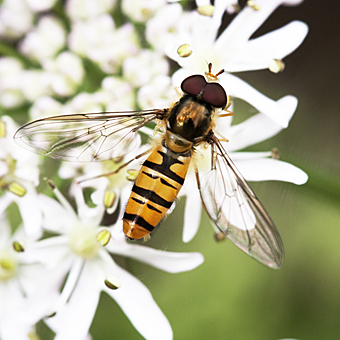
Although primarily a wetland area, PC tends to get a quite a number of different species, one of the most attractive of which is Sphaerophoria scripta (♂and♀ pictured), a locally uncommon slender fly which appears regularly, but numbers vary from year to year. Unfortunately, due to space constraints it is impossible to do justice to this most interesting group of insects, but some are worthy of further comment inasmuch as they may be commonly seen anywhere on the Reserve. One of these is Episyrphus balteatus, sometimes referred to as the “Marmalade Fly” due to the thick and thin horizontal abdominal stripes (see image). This is a species which can overwinter as an adult and is one of our commoner hoverflies at certain times of the year with its numbers being boosted by a large influx of migrants from Europe, brought over by the prevailing winds.
Episyrphus balteatus “Marmalade Fly” © Allan Parker ARPS
Leucozona lucorum (see image) is a different but quite unmistakable species with its large whitish-yellow square spots on the second tergite (upper segment). It also exhibits a dark wing cloud, one of the features which help identification. This is a typical spring hoverfly which likes lush vegetation particularly on the sunny side of woodland margins in wetland areas.
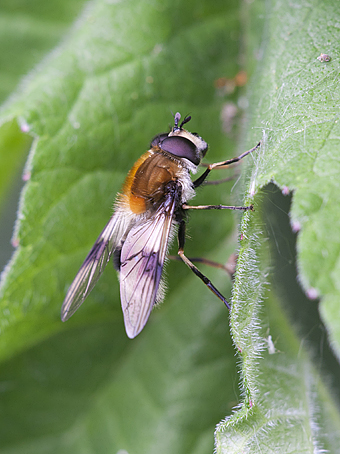
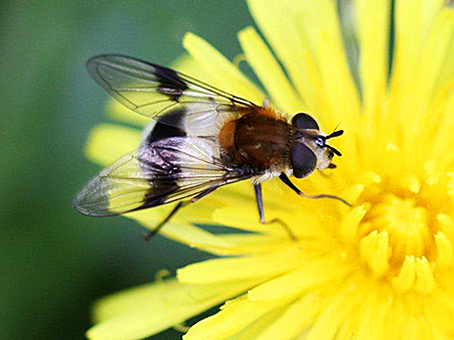
Leucozona lucorum © left, Allan Parker ARPS and right Derek Bateson
The next species, Helophilus pendulus is one of group known as “footballers”, due to the vertical thoracic stripes. Distribution is widespread and it is one of our commonest species, often sunning itself on leaves when not visiting flowers, sometimes emitting a low buzzing noise (this is now out of my hearing range!). The image shows a mated pair, clearly showing the distinguishing leg colouration which aids and determines accurate identification.
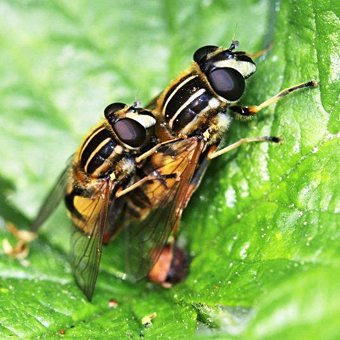
Helophilus pendulus mated pair © Derek Bateson
A fairly new species to the Reserve, is Sericomyia silentis (see image). This is a large and quite colourful hoverfly with wedge-shaped yellow bars on the tergites, and is a Local species here, hence it has not been previously recorded. Another interesting but much smaller and elusive species, Tropidia scita (see image ) has only been infrequently recorded. These hoverflies have very distinctive swollen femora with a triangular process which is readily visible to the naked eye and is a diagnostic feature. Another newly recorded species is Rhingia campestris (see image); this is known as the "Pinocchio Fly" because of its long distinctive snout
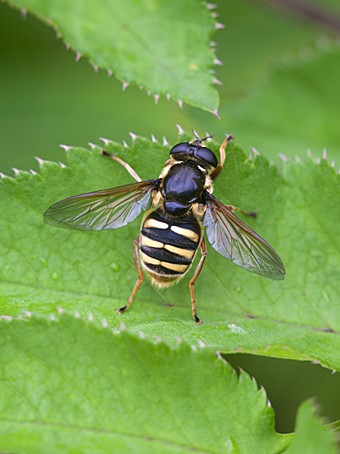
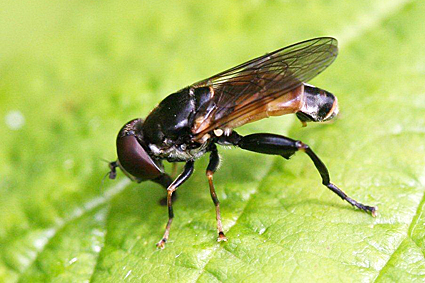
Left, Sericomyia silentis © Allan Parker ARPS and right Tropidia scita © Derek Bateson
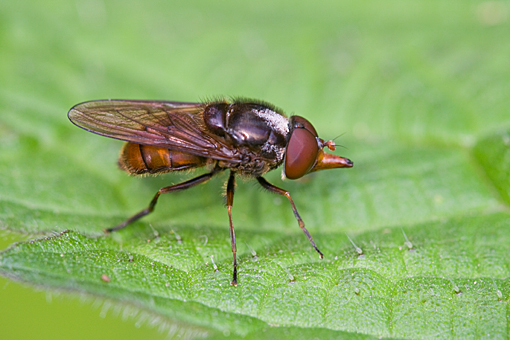
Rhingia campestris "Pinocchio Fly" © Allan Parker ARPS
Finally, Myathropa florae, one of our larger hoverflies; this is a colourful yellow and black wasp mimic and is often referred to as “The Chinaman” by entomologists, due to the distinctive face pattern on the thoracic dorsum (see image). It is fairly common in late summer when it can readily be found on the umbels of Hogweed, Heracleum sphondylium.
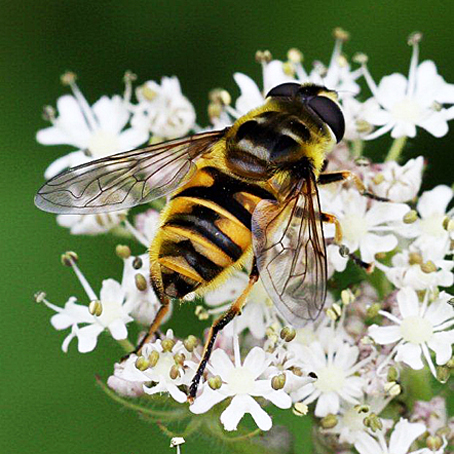
Myathropa florea "The Chinaman" © Derek Bateson
Many other hoverflies, even the smaller species offer the amateur entomologist or photographer, hours of enjoyment, seeking out, recording and photographing some of these jewels of the natural world.
© Derek Bateson 2012
Below are more images of Hoverfly from Potteric Carr N.R.
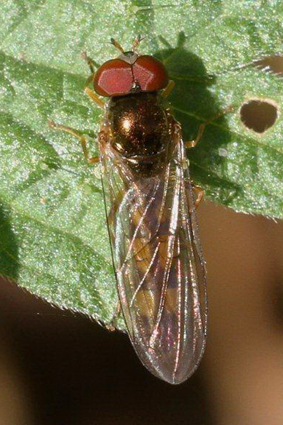
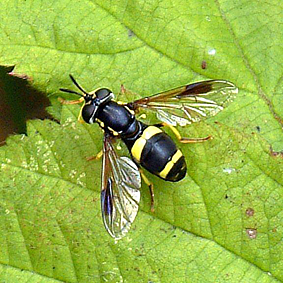
Left, Melanostoma scalare and right, Chrysotoxum bicinctum both images © Derek Bateson
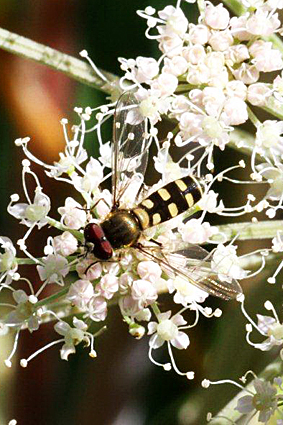
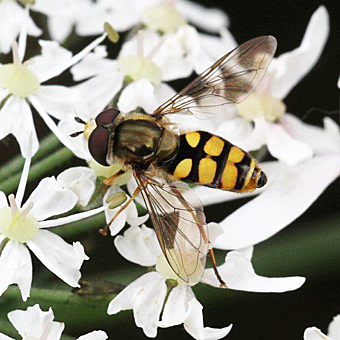
Left, Melangyna umbellatarum and right Eupeodes corollae both images © Derek Bateson
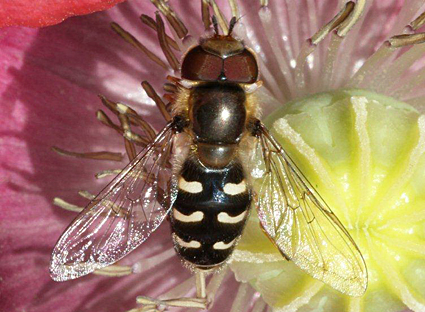
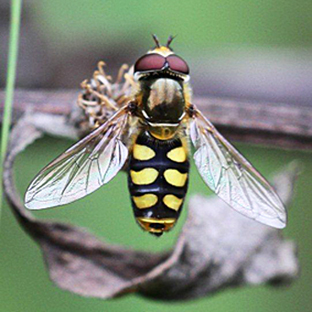
Left, Scaeva pyrastri and right, Scaeva albomaculata both images © Derek Bateson
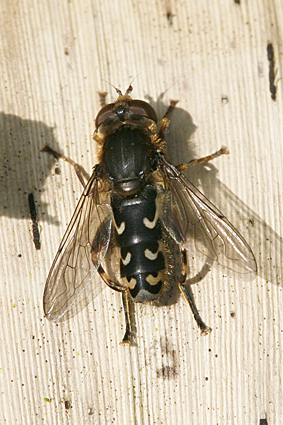
Anisimyia contracta © Ken Woolley
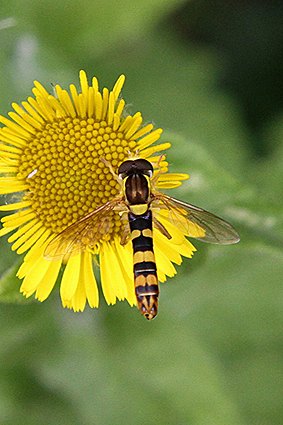
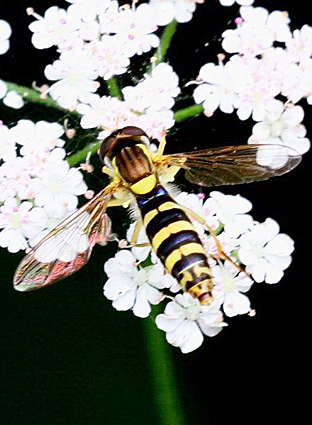
Left, Sphaerophoria scripta male © Ray Collins and right female © Derek Bateson
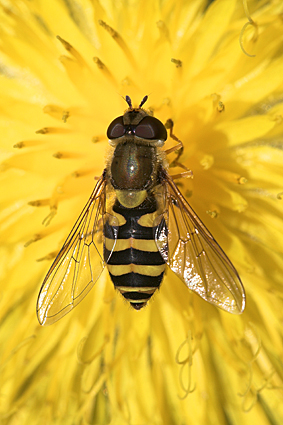
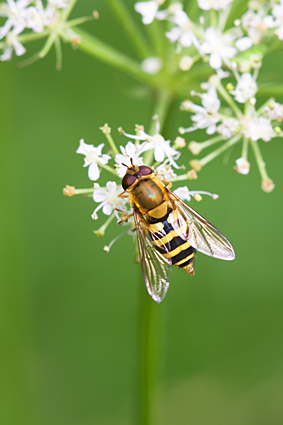
Left, Syrphus ribesii and right Syrphus vitripennis both images © Allan Parker ARPS
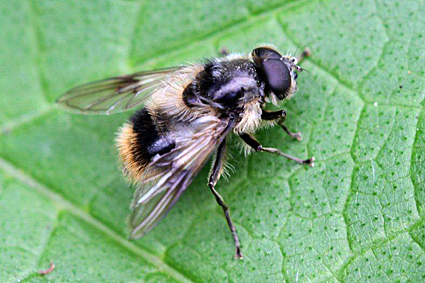
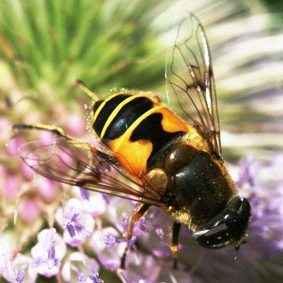
Left, Cheilosia illustrata and right Eristalis horticola both images © Derek Bateson
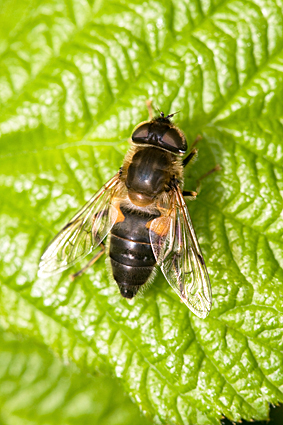
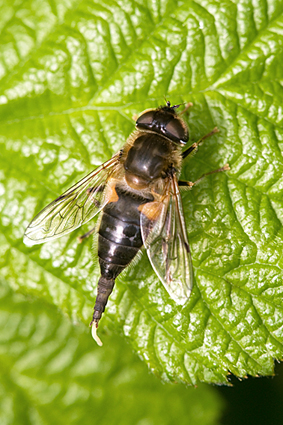
Eristalis pertinax both images © Allan Parker ARPS
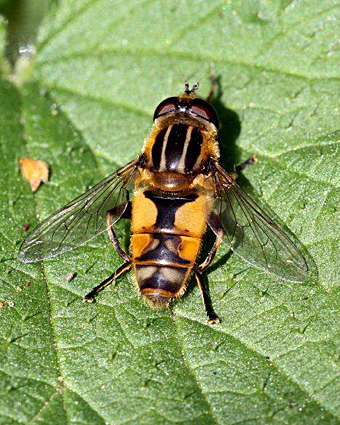
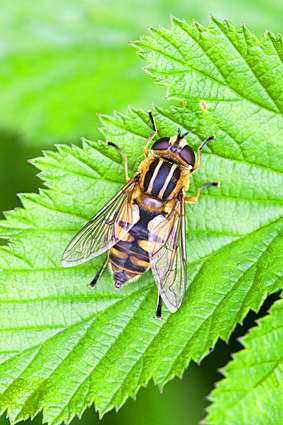
Left, Helophilus hybridus "Footballer" © Derek Bateson and right, Helophilus pendulus "Footballer" © Allan Parker ARPS
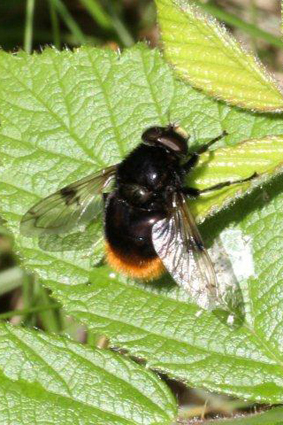
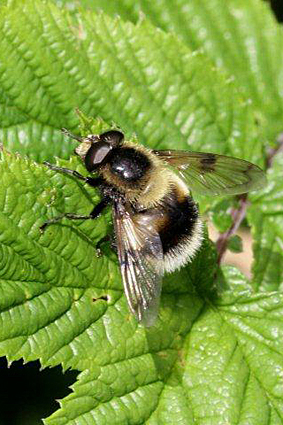
Left, Volucella bombylans and right, white-tailed form, both images © Derek Bateson
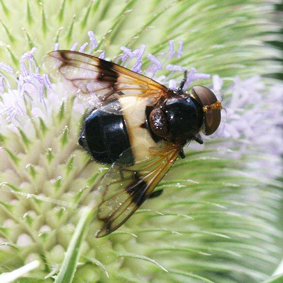
Volucella pellucens © Derek Bateson
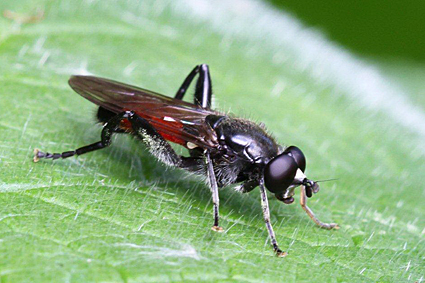
Brachypalpoides lentus © Derek Bateson
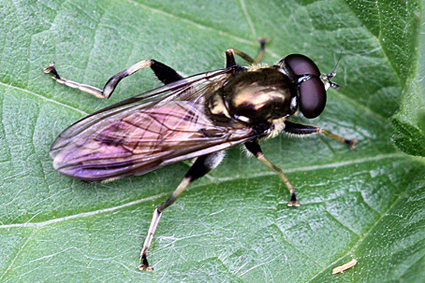
Xylota segnis © Derek Bateson