Early and late dates for 2011 together with the earliest and latest sightings recorded at Potteric Carr and the mean date based on the period 2000 to 2011 can be found
 .
Observers are asked to report early and late butterfly dates at Potteric Carr in 2012.
.
Observers are asked to report early and late butterfly dates at Potteric Carr in 2012.
Butterfly watching at Potteric Carr
Potteric Carr is generally a good place to watch and get to know a range of butterflies, most of which can easily be seen from the many paths. For information on identification and more detailed studies into butterflies please refer to The List of Species below which contains many references.
For identification in the field, two field guides are highly recommended – The Pocket Guide to Butterflies of Great Britain and Ireland , Richard Lewington, British Wildlife Publishing, or Guide to Butterflies of Britain and Ireland , J. A. Thomas and Richard Lewington, Philips, 2008. Both are available for around £10.
The following list includes butterflies that have been recorded at least a few times in more than one year in the last 20 years. Those species marked with X are now considered to be extinct on the Reserve. Two additional species have been recorded in recent years; they are Dark-Green Fritillary Argynnis aglaja (2003) and Marbled White Melanargia galathea (2006).
Abundance : The letter following the species name, gives relative abundance (estimated peak number on any one day in the appropriate flight season) using the standard Biological Records Centre nomenclature, i.e. A = 1; B = 2-5; C = 6-20; D = 21-100; E = 100–500. Relative abundance is not stated for purely migrant species whose numbers can vary wildly from year to year.
Breeding : Little work has been done on establishing proof of breeding – but the following codes indicate current status:-
P = Male and female present in suitable habitat
O = egg found
L = caterpillar found
Ch = chrysalis found
V = uncommon visitor
X = extinct
Small Skipper Thymelicus sylvestris (C/D)
This butterfly is present from mid June to mid-August, with peak counts occurring in early/mid-July. It was described in the 70s as “ abundant with daily counts of over 100 ” ( Rimington, 1992 ). Up to 2002, the number of this species increased reaching a maximum daily count of 417 in 2002 ( Hancox, 2003 ). However, during the last five years, there has been a decline at Potteric Carr with the maximum daily count falling to 12 in 2009. The reason for the decline at Potteric Carr appears to be due to the lack of its food plant, Yorkshire Fog Holcus lanatus . This may be due to the activity of rabbits, particularly in Black Carr Field. Attempts are being made to enable areas of Yorkshire Fog to become re-established. P
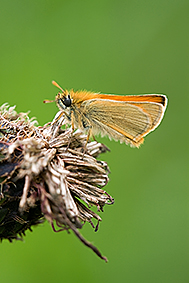
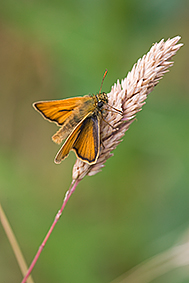
© Allan Parker ARPS
Large Skipper Ochlodes sylvanus (formerly Ochlodes venatus) (C/D)
This butterfly is present in small numbers. It is similar to the Small Skipper with which it is sometimes confused. It can be seen near many of the paths in 1s and 2s from end May to early August, and daily peak counts have varied between 17 and 36. The population appears to be relatively stable. Breeding is dependent on its food plants, including Cocksfoot Dactylis glomerata and False Brome Brachypodium pinnatum . P
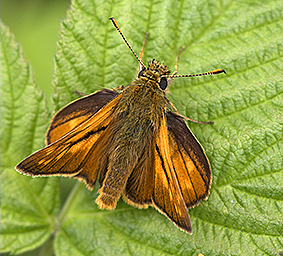
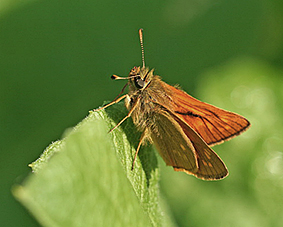
© Allan Parker ARPS © Glyn Hudson
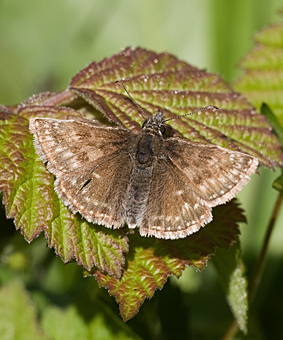
Dingy Skipper Erynnis tages
This butterfly is now extinct on the Reserve having declined since the 1980s. It was never very common and has been recorded only sporadically since it was first seen in the 60s. Heppenstall ( 1974/76 ) considered it extinct in 1974 but ‘rediscovered’ it in 1976. Rimington ( 1992 ) reported it as “ unusually common in 1983 ”, whilst Fenton ( 1988 ) reported it in 2s and 3s which coincides with the writer’s own recollections of that time. Last recorded on 25th May 1993. X
© Allan Parker ARPS
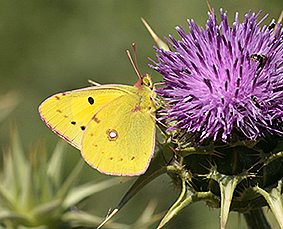
Clouded Yellow Colias croceus
There are occasional sightings most years of this fairly uncommon migratory species in Yorkshire. When seen, it is usually flying strongly through the Reserve. In recent times, 1983 and 1996 were “Clouded Yellow years” ( Asher et al, 2001 ); many were recorded at Potteric Carr in 1983 ( Carroll, 1984 ). After a few relatively barren years, 2007 saw a number of sightings in the autumn on the rough margins of the new marshes at Huxter Well. V
© Glyn Hudson
Brimstone Gonepteryx rhamni (D)
The butterfly is regularly seen in 1s and 2s from February to November, anywhere on the Reserve. Heppenstall ( 1973 ) reported it as being “ almost as rare …as Comma ”. In 1975, eggs were reported on Alder Buckthorns ( Heppenstall, 1976 ). Rimington (1992 ) reported c ounts of 5 – 20 per day in 1986, an obvious increase. With peak daily counts now between 15 and 25, it would appear that the population may have stabilised at around this level. O
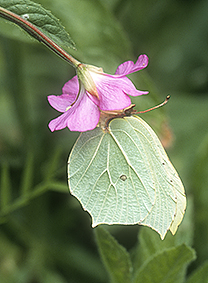
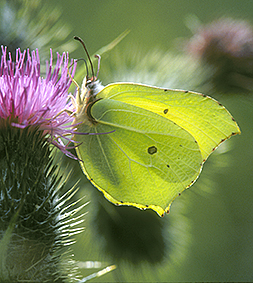
Left, female and right male © Allan Parker ARPS
Large White Pieris brassicae (D/E)
On the wing from April to October and seen in many parts of the Reserve. It is never very common and is seen mostly only in 1s and 2s. However, there are occasional counts of 60+; these are almost certainly of continental immigrants which regularly boost the British population. Its population on the Reserve is probably stable. However, many of those seen have almost certainly bred elsewhere.
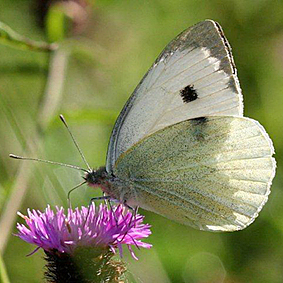
© Derek Bateson
Small White Pieris rapae (D)
Heppenstall ( 1976 ) remarked that this species was present in “ unprecedented numbers ”, whilst Fenton ( 1989 ) reported it as less common than Large White. Recent records show that this species is probably more common. They are on the wing from early March to October when they are seen in 1s and 2s generally flying through areas. Most larger counts come from the period early July to mid-August when as many as 60+ may be counted in an average day, this number almost certainly being boosted by continental migrants. The population may be fairly stable, many of those seen almost certainly having bred elsewhere.
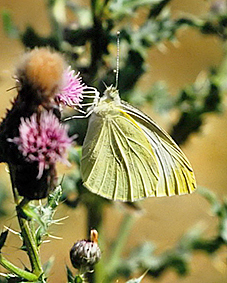
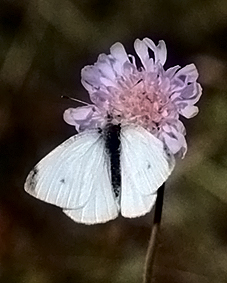
Left, underside and right male © John Lintin Smith
Green-veined White Pieris napi (D)
This species prefers damp situations and Potteric Carr would seem to be ideal habitat which is probably why it is the most widespread of all the ‘whites’ on the Reserve and usually the most common although its numbers are not boosted by immigrants as with the previous two species. It normally appears early in April and is on the wing until mid October. There is a small peak in May (1st brood), with a larger peak in late July (2nd brood). The population appears to be stable. O
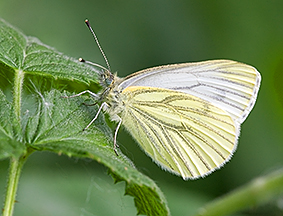
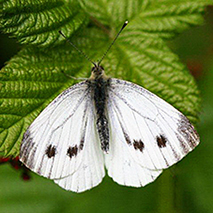
Left © Allan Parker ARPS and right female 2nd brood © Derek Bateson
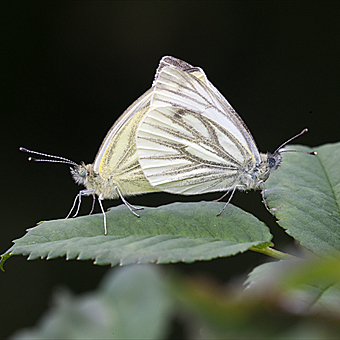
Mated pair © Allan Parker ARPS
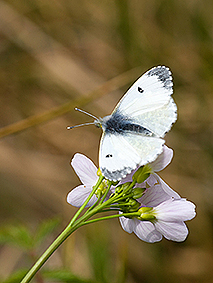
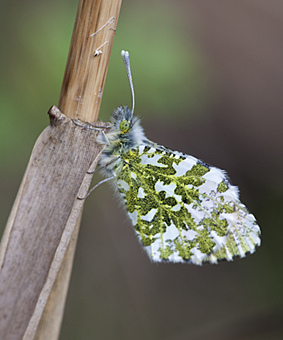
Orange-tip Anthocharis cardamines (D)
Usually on the wing from early April to late June, but can be variable. Mainly males are recorded in small numbers all over the Reserve with a peak daily count of 50+ in good years. Females are recorded much less frequently possibly due to their retiring habits and tending to stay near the food plant. Eggs have been seen on the food plant Cuckoo Flower (Lady’s Smock) Cardamines pratense and Garlic Mustard (Jack-by-the-Hedge) Alliaria petiolata . The population appears to be stable or possibly increasing. O
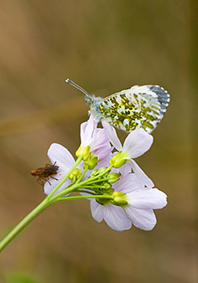
Female © Allan Parker ARPS
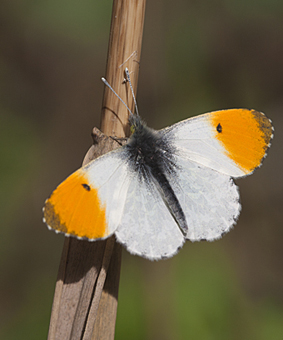
Male © Allan Parker ARPS
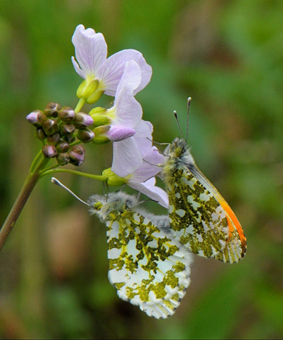
Mated pair © Peter Dawson
Purple Hairstreak Favonius quercus (C)
Regarded as being “extinct” in Doncaster ( Rimington, 1992 ), this butterfly was discovered at Potteric Carr in July 1997 on Willow Bank and Loversall Bank. It now appears to be present in the oaks here and in other parts of the Reserve and can be seen from early July. However, because the weather conditions are critical to viewing opportunities (sunny, warm, still afternoons), the annual numbers recorded are very variable and may not be a true indication of population level. An individual was seen ovipositing in August 1999. The numbers of the original find, and the discovery of other butterflies in other parts of the Reserve, means that this species has probably been in existence and overlooked prior to its re-discovery. O
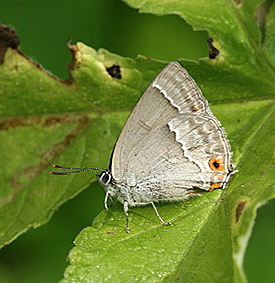
© Glyn Hudson
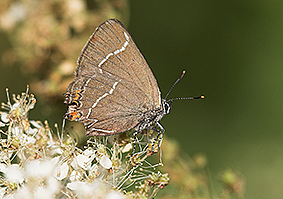
White-letter Hairstreak Satyrium w-album (C)
Apart from an old record at Potteric Carr in 1983 ( Sutton & Beaumont, 1989 ), the first recent sighting was of a nectaring female in July 2001. In mid-May 2002, a larva was seen on a single Wych Elm on Loversall Bank, through a telescope. Since their first discovery in 2001, there have been regular sightings, usually from mid June, particularly in the Wych Elm on Loversall Bank with an increasing number of sightings in other parts of the Reserve where Wych Elm is present. L
© Allan Parker ARPS
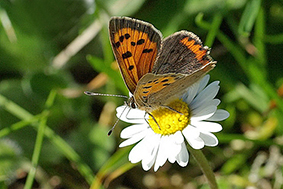
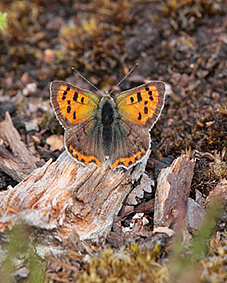
Small Copper Lycaena phlaeas (B)
This often elusive and difficult to see butterfly is mostly seen in 1s or 2s mainly near paths where nectaring plants are present - often on relatively bare areas, the Devil's-bit Scabious Succisa pratensis in Black Carr Field can be a favourite spot in early autumn. More numerous in some years than others but population probably relatively stable. An example of the aberrant form caeruleo-punctata , which has a series of variable blue spots on the hind wing, is occasionally seen. Three broods - May, July and September.
© John Hancox © Glyn Hudson
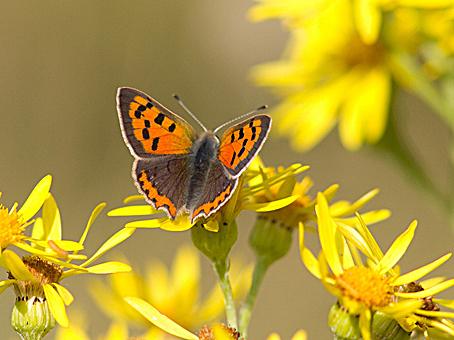
Aberrant form caeruleo - punctata showing the blue spots on the hind wing © Barry Wardley
Brown Argus Aricia agestis (B)
This species was first discovered in June 2000 when a small colony was found on the bank of Mother Drain near the pumping station. Newly emerged butterflies were seen, indicating that there may have been a small colony on or near the Reserve for a time. Numbers seem to vary each year – this may be actual absence or due simply to not being spotted – it is the smallest butterfly on the Reserve. It is now seen in many parts of the Reserve, the first brood in June and second brood in August. (NB: confusion has reigned because some individuals have white marks around the dark spots on the forewings. This has been interpreted as indicating the closely related species Northern Brown Argus A. artaxerxes , but the species at Potteric Carr is definitely A. agestis ). P
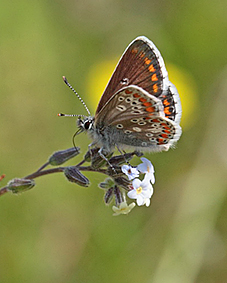
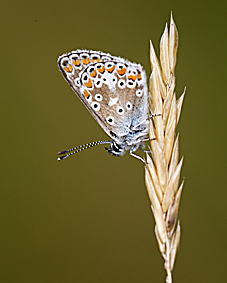
Left, Male © Glyn Hudson and right male underside © Allan Parker ARPS
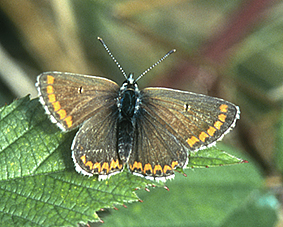
Female upper wing © Allan Parker ARPS
Common Blue Polyommatus icarus (D/E)
Recorded from mid-May to mid-September with a first brood peak around the end May/early June, and a second brood peak normally in August. Regularly seen from the paths in some parts of the Reserve. Female easily overlooked due to its brown coloration (similar to Brown Argus!). It was noted as “abundant” at Potteric Carr in 1973 ( Rimington, 1992 ). During the 80s, it became fairly common at Potteric Carr and the population appeared to be stable. However, it has recently shown wild swings in numbers, the reason for which is not known but may be weather related. Numbers have been low particularly in the last three years! P
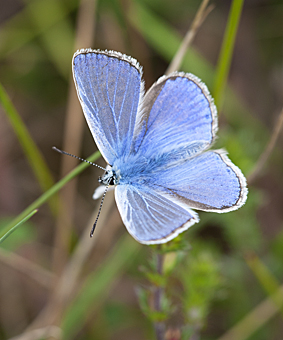
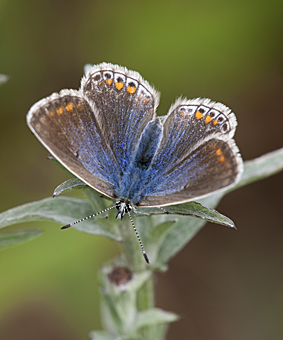
Left, male and right female © Allan Parker ARPS
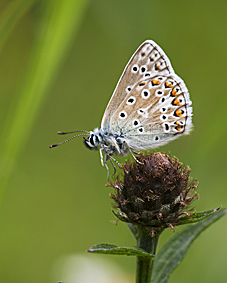
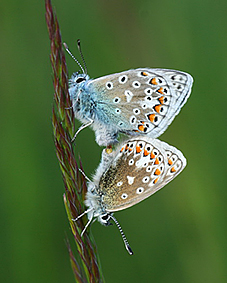
Left, male underside © Allan Parker ARPS and right mated pair male upper & female lower © Glyn Hudson
Holly Blue Celastrina argiolus (B)
This species moved into the Reserve in the 90s and is seen in small numbers from April to May and July and August. The number of sightings varies from year to year indicating perhaps that it is merely passing through having bred elsewhere. Of the two food plants, Holly is only present near the northern boundary of the Reserve and there are only small patches of Ivy, its other food plant. V
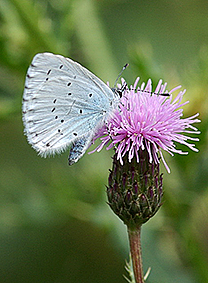
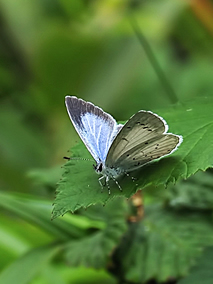
Left, © John Hancox and right © Peter Dawson
Red Admiral Vanessa atalanta
Recorded regularly at Potteric Carr, with numbers varying markedly from year to year, depending the level of immigration (from Southern Europe and North Africa) and the level of subsequent local breeding. They generally arrive in late spring with peak numbers appearing from late July through to autumn. Major immigration years have been 1982, 1992 and 1996 ( Asher et al, 2001 ). L
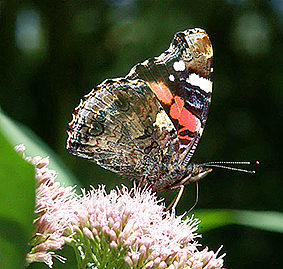
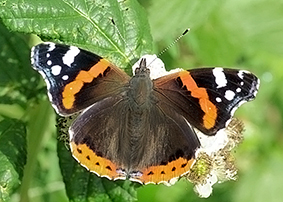
© John Hancox © John Hancox
Painted Lady Cynthia cardui
This migrant butterfly (from Southern Europe and North Africa) is recorded in 1s and 2s in most years, mainly following arrival in spring. However, there are years of major immigration when large numbers occur in Britain. 1980, 1988 and 1996 were such years ( Sutton & Beaumont, 1989 ), with larger numbers occurring, almost certainly from local breeding, in late July/early August. In recent years, 2006 experienced larger than usual numbers, but could not be described as a vintage year in comparison with 1980 or 1996. In 2009, millions were reported arriving in Britain on migration from the continent in spring, but apart from butterflies seen “flying through” the Reserve at that time, the anticipated high numbers resulting from local breeding never materialised – probably due to the weather conditions. L
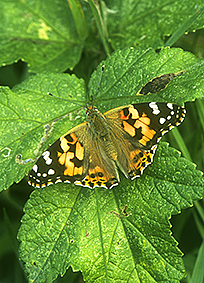
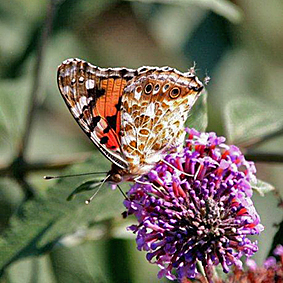
Left, © Allan Parker ARPS and © Derek Bateson
Small Tortoiseshell Aglais urticae (C)
Over the last 20 years, numbers have been relatively low, both locally and nationally, numbers at Potteric Carr rarely reaching double figures. Whilst there is normally a large native population in Britain, numbers are supplemented by immigrants. The reason for the smaller numbers in recent years is unknown but it is now thought that a parasitic insect could be the cause of the decline. In normal times, this highly mobile species can be seen anywhere on the Reserve, particularly in late summer. L
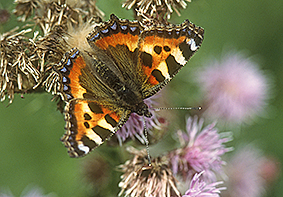
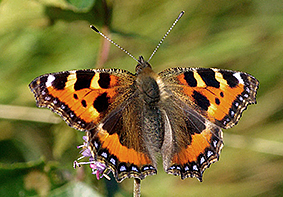
Left, © Allan Parker ARPS and right, © John Hancox
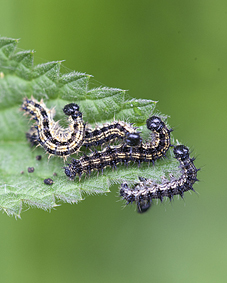
Caterpillars © Allan Parker ARPS
Peacock Aglais io (E)
This is one of the Reserve’s most common butterflies most years. It is a highly mobile species which is widespread and occurs virtually anywhere on the Reserve where nectar-bearing flowers occur. Overwintering imagines can emerge from hibernation as early as February. The species can then be seen in every month to October / November with a short gap in June / July. Maximum counts occur in end April / early May for those which have overwintered and in high summer usually late July / early August for that year’s brood. In some years, numbers are supplemented by immigrants from the continent. From September, fewer numbers are seen as most will be hibernating. L
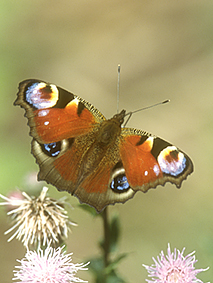
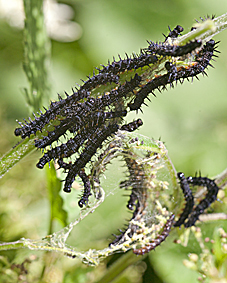
Left adult and right, caterpillars © Allan Parker ARPS
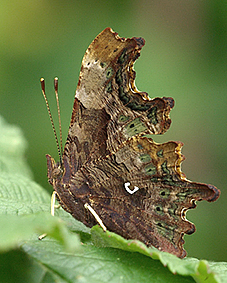
Comma Polygonia c-album (D)
This butterfly extended its range northwards in Britain in the late 80s and 90s, the first record on the Reserve since 1973 being in October 1989. Since then the number of sightings has increased to the extent that it is now a fairly common sight in spring (overwintered butterflies). The overwintered butterflies breed around 30% of which emerge in early summer brood appearing in June (form Hutchinsoni ), the remainder emerging in August. The Hutchinsoni form breed to produce a brood which also emerges in the autumn. One of the best times to see them is in autumn when they are often seen “drinking” the juices of blackberry which may have started to ferment, when they (and often other insects) can be extremely docile (inebriated!). They are more plentiful in some years than others, particularly the early summer brood. L
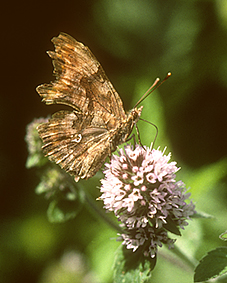
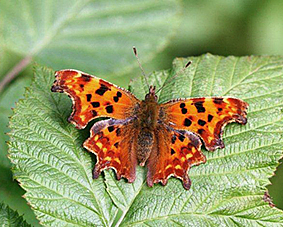
Left, © Allan Parker ARPS and right © Derek Bateson
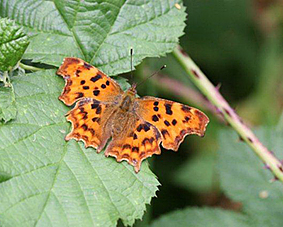
Form Hutchinsoni left © John Hancox and right © Derek Bateson
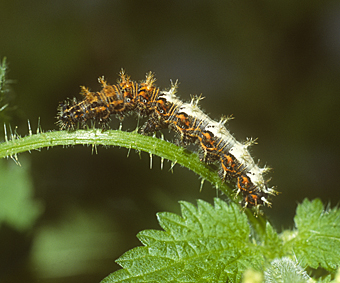
Caterpillar © Allan Parker ARPS
Dark-green Fritillary Parage aglaja (A)
Just one record in 2003 (PG) V
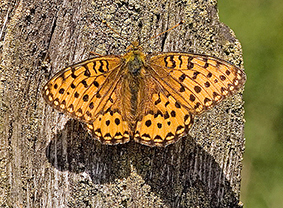
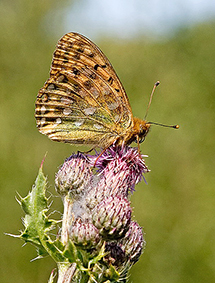
Images © Glyn Hudson
Marbled White Melanargia galathea (A)
Just two records in 2006 (JH & MR) V
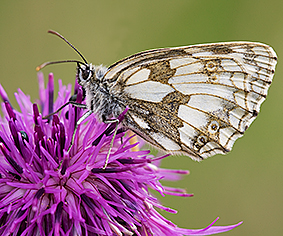
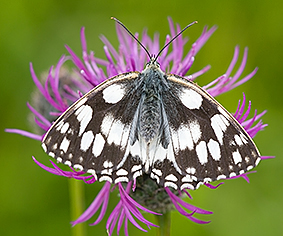
© Allan Parker ARPS
Speckled Wood Pararge aegeria (D/E)
This is another butterfly that colonised the Reserve in the 1980s as it extended its range northwards in Britain. Since it was first recorded in 1987, it rapidly increased its numbers and quickly became very common. The species is unusual in that they can overwinter either as caterpillars or chrysalises. The ones wintering as caterpillars appear first during April (or occasionally March), and the ones from the chrysalises somewhat later in May/June giving the appearance of two broods but in fact are a single generation. During this period, maximum counts are around 20. These butterflies produce a second generation (from August) when counts regularly exceed 100 and at this time they are easily the most common butterfly on the Reserve. There may be a third brood, i.e. a few that are still around in November, but this is difficult to ascertain. However, there are few days in the overall flight season (April-November) when there isn’t at least one Speckled Wood to be seen – they are even reasonably tolerant of cloudy, damp and cool weather. They can be seen almost anywhere from many of the paths, particularly Loversall Bank and Willow Bank, and in dappled shade in woodland such as Black Carr Wood. Population probably stable. P
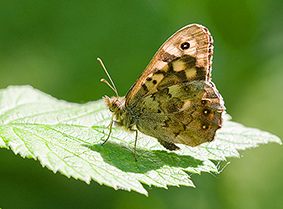
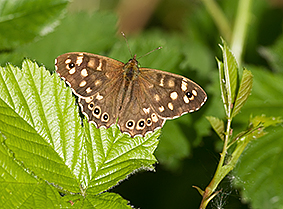
© Allan Parker ARPS
Wall Brown Lasiommata megera
This once relatively common butterfly is now extinct as a species on the Reserve. This coincides with a decline nationally, particularly on inland sites since the mid 80s. X
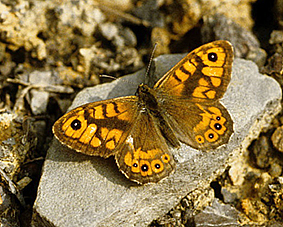
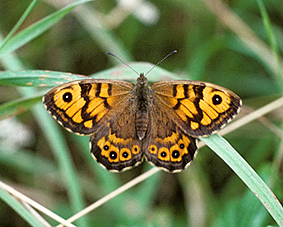
Left male and right female © John Lintin Smith
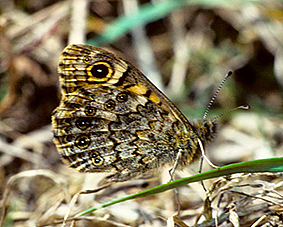
© John Lintin Smith
Gatekeeper Pyronia tithonus (Hedge Brown) (E)
This butterfly was almost extinct in northern England up to the 1960s. It was first noted on the Reserve in 1971 ( Rimington, 1992 ) following an expansion of its range ( Sutton and Beaumont, 1989 ), which still continues. It is now the most common butterfly on the Reserve during its short flight period from early July to mid August. Coordinated daily counts from all areas of the Reserve in July between 2000-2003 realised increasing numbers with the maximum of over a 1,060 individuals being reached in 2003. Since 2003, however, the numbers have declined somewhat, though the butterfly is still relatively common in July. The reason for the decline is not known but may be due to a series of poor summers (particularly heavy rain coinciding with its emergence), and a loss of nectaring food plants. P
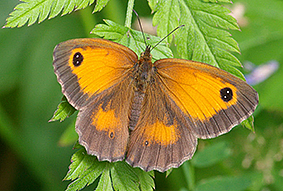
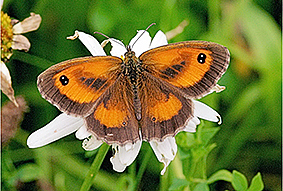
Left, Female and right, male © John Hancox
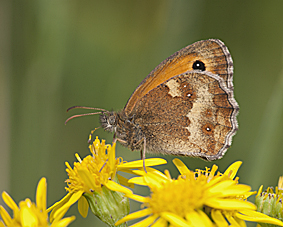
Male underwing © Allan Parker ARPS
Meadow Brown Maniola jurtina (D/E)
Heppenstall ( 1976 ) remarked that this was the commonest butterfly on the Reserve with an estimate of over 1,000 individuals in July 1976. The population has declined since 1976, probably due to loss of breeding habitat. It’s population is now probably relatively stable but at a lower level. Its habitat preference is for wild grassy areas (Frost 2005). It is, however, still fairly common in certain areas of rough grass and may be under-recorded. Later in the season, very faded, worn individuals are easily confused with faded Ringlets! P
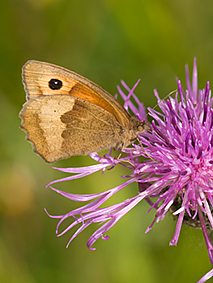
© Allan Parker ARPS
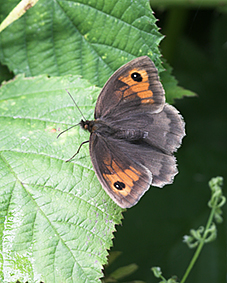
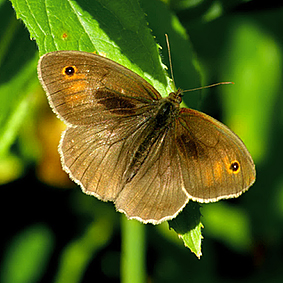
Left female © Allan Parker ARPS and right male © John Hancox
Ringlet Aphantopus hyperantus (D/E)
This is another of the recent colonisers of the Reserve being first observed in 1984 since when it has become very common during its relatively short flight period from early June to August. It is most commonly seen near the footpaths, particularly along Loversall Bank and Cottage Drain. Sanderson ( 1987 ) and Fenton ( 1988 ) reported it in other parts of the Reserve which it still frequents. It has a characteristic ‘fluttery’, apparently weak flight. The population is now probably fairly stable, but there appear to be marked changes in abundance from year to year often at different times in the short flight period, maybe pointing to the weather being a factor. P
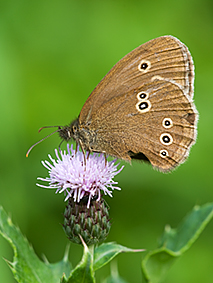
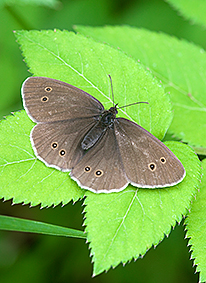
Both images © Allan Parker ARPS
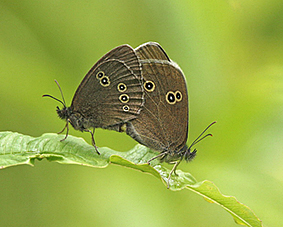
© Glyn Hudson
Small Heath Coenonympha pamphilus
This formerly fairly common species is now extinct on the Reserve, no records being received for many years. Rimington ( 1992 ) reported it “ present at Potteric Carr with daily counts between 20 and 100 ”. Sanderson ( 1987 ) and Fenton ( 1988 ) reported it being “ frequent ”, with daily counts 15 and 12+ respectively. The decline at Potteric Carr is almost certainly due to lack of suitable habitat, experiments demonstrating a preference for grassland with a short sward containing patches of low growing flowering plants ( Emmet & Heath, 1989 ), a habitat which is non-existent at Potteric Carr. Some concern is also being expressed about this species’ decline nationally ( Asher, 2001) . X
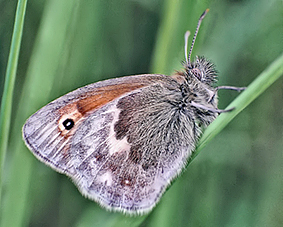
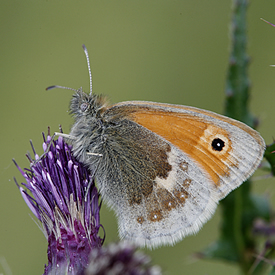
Left, © John Hancox and right, © Ken Woolley
Flight times
Early and late dates for 2011 together with the earliest and latest sightings recorded at Potteric Carr and the mean date based on the period 2000 to 2011 can be found
 .
.
References
The following is a list of further references.
Asher, J. et al, The Millennium Atlas of Butterflies in Britain and Ireland , Oxford University Press, 2001
Beaumont, H., Butterflies and Moths of Yorkshire , A Millennium Review, Yorkshire Naturalists’ Union, 2002
Carroll, D., in The Doncaster Naturalist, Occurrences of the Clouded Yellow in the Doncaster Area, Doncaster Naturalists’ Society, 1984
Emmet and Heath, The Moths and Butterflies of Great Britain and Ireland , Volume 7, Part 1, Harley Books, 1989.
Fenton, G. A., Potteric Carr Nature Reserve, Summary of Butterfly Records 1988 , PCNR Management Committee, 1988
Fenton, G. A., Potteric Carr Nature Reserve, Butterfly Report 1989/90 , PCNR Management Committee, 1990
Frost, H. M., The Butterflies of Yorkshire , Butterfly Conservation, 2005
Hancox, J., Butterflies of Potteric Carr , PCNR Management Committee, 1998-2002
Hancox, J., in Potteric Carr Recorder , Issue No. 3, PCNR Management Committee, 2000
Hancox, J., in Potteric Carr Recorder , Issue No. 6, PCNR Management Committee, 2003
Heppenstall, R. I., in Potteric Carr Nature Reserve Annual Reports for 1973 to 1976 , Report on Butterflies and Moths, PCNR Management Committee, 1973-1976
Higgins, L. G., The Butterflies of Britain and Europe , Collins, Paperback, 1983, (1985 edition)
Higgins, L. G., Field Guide to the Butterflies of Britain and Europe , Collins, 1970
Lewington, R., Pocket Guide to Butterflies of Great Britain and Ireland , British Wildlife Publishing, 2003
Lewington, R. and Tolman, T., Collins Butterfly Guide , Collins, 2009
Rimington, E., Butterflies of the Doncaster District , Sorby Record Special Series No. 9, Sheffield Sorby Natural History Society and Sheffield City Museums, 1992
Sanderson, N. K., Potteric Carr Nature Reserve, Summary of Butterfly Records 1987 , PCNR Management Committee, 1987
Stokoe, W. J., The Observer’s Book of Butterflies , Warne, 1960 (reprinted many times)
Sutton, S. L. and Beaumont, H. E., Butterflies and Moths of Yorkshire , YNU ,1989
Thomas, J. A., Guide to Butterflies of Britain and Ireland , Philips, 2008
Thomas, J. A., Lewington, R. Butterflies of Britain and Ireland , British Wildlife Publishing, 2010
Tomlinson, D., Still, R., Britain’s Butterflies , WildGuides, 2002
Whalley, P., Butterfly Watching , Severn House Naturalist’s Library, 1980
text © John Hancox